Catholic Wedding Rehearsal: Complete Guide + Checklist


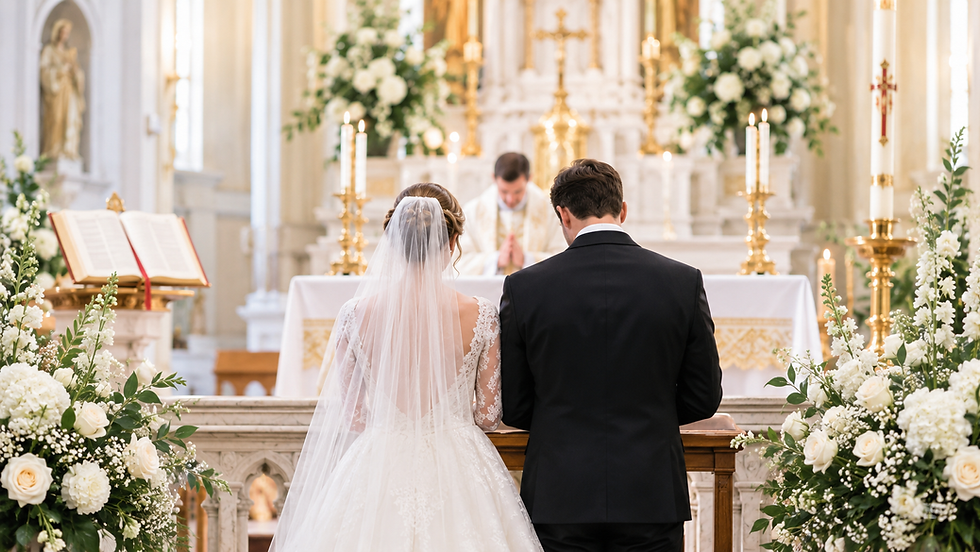
A Catholic wedding rehearsal is, at its heart, a practical walk-through of your wedding ceremony: it's when your wedding party and family gather at the church, usually a day or two beforehand, to practice the entrances, positions, transitions, and cues so that everyone knows exactly where to go and what to do on the wedding day. Rather than a full run of the ceremony itself, it's a chance to remove the guesswork—where to line up, who walks when, where to stand during the exchange of consent, and how to make a graceful exit—so that on your wedding day you can be present to the sacrament instead of worrying about logistics.
Think of the rehearsal as choreography, not performance. You'll typically practice the processional (how everyone enters), where the wedding party and family sit and stand, the general flow of the readings and the Celebration of Matrimony, the ring and vow logistics, and the recessional—along with any instructions specific to your parish. Your priest, deacon, or parish wedding coordinator decides how much of this is actually rehearsed on the night, and their guidance always comes first.
One clarification worth making right away: the rehearsal is not a rehearsal of the Mass itself. The sacred parts of the liturgy—the readings proclaimed in full, the exchange of consent word-for-word, the Eucharistic Prayer—are generally not "performed" in advance. What you're rehearsing is movement and timing so the liturgy can unfold reverently and without confusion. If you'd like a fuller picture of how everyone enters before the rehearsal even begins, our guide to the Catholic wedding processional order is a helpful companion to this one.
A rehearsal can feel especially valuable when:
members of your wedding party aren't Catholic and may be unfamiliar with the flow of the liturgy
you're celebrating a full Nuptial Mass rather than a ceremony outside of Mass
you have multiple readers or gift bearers who need to know their cues
the church is unfamiliar to your wedding party
you're incorporating Catholic cultural traditions that require coordination
In every one of those cases, thirty focused minutes in the church ahead of time is worth far more than its length in peace of mind.
Do Catholic Weddings Have Rehearsals?
Usually, yes—though the arrangements vary by parish. Most parishes hold a wedding rehearsal as a matter of course, and the parish, not the couple, normally schedules it. Because the church is a working house of worship with its own calendar of Masses, confessions, and other weddings, the parish also sets the rules around timing, attendance, and who directs the rehearsal.
A few things that commonly hold true, with the understanding that none of them is universal:
Rehearsals are often held the evening before the wedding, but not always—church availability drives the timing more than tradition does.
They typically last somewhere around 30 to 60 minutes.
The priest or deacon may lead the entire rehearsal, part of it, or none of it in person.
A parish wedding coordinator, sacristan, or other designated representative frequently directs the practical logistics.
Couples should follow their parish's specific instructions rather than assuming that customs from secular weddings—or from a wedding they attended elsewhere—apply to theirs.
The safest posture is to treat generic wedding-rehearsal advice (including this article) as a helpful map, and your parish's direction as the actual terrain.
Check With Your Parish Every parish handles wedding rehearsals somewhat differently. Your priest, deacon, or parish wedding coordinator should always be your final authority for the logistics of your particular celebration. When something in a general guide seems to conflict with what your parish tells you, follow your parish.
Who Should Attend a Catholic Wedding Rehearsal?
The short answer: everyone who has a role to play in the ceremony's movement. In practice, the likely attendees include:
the bride and groom
the maid or matron of honor
the best man
the bridesmaids and groomsmen
the flower girl and ring bearer, if they're participating
parents, if they're part of the procession or have another role
the readers (lectors)
gift bearers, for a wedding within Mass, if the parish wants them rehearsed
anyone taking part in a permitted cultural or devotional tradition that needs coordination
Readers deserve special mention: they should attend whenever possible. A reader may needs to know how to work the microphone, and where to return afterward. Reading well in an unfamiliar sanctuary is much easier after you've stood in the exact spot once.
A note on who doesn't automatically need to be there: extraordinary ministers of Holy Communion, altar servers, cantors, and musicians serve important roles in the liturgy, but they don't necessarily attend the wedding rehearsal unless your parish specifically asks them to. Many parishes handle those ministries through their own regular scheduling. Ask your coordinator whom they'd like present rather than assuming.
What Happens at a Catholic Wedding Rehearsal?
This is the part most couples want to picture in advance. While the exact sequence depends on your parish and celebrant, most rehearsals move through the same practical stages.

1. Getting Everyone in Place
The coordinator usually begins by orienting everyone to the space and establishing where each person belongs. Expect them to identify:
where the wedding party waits before the procession begins
where the attendants stand or sit during the ceremony
the bride's and groom's positions
where parents and immediate family sit
where readers and other participants sit so they can reach their roles easily
This is also when you'll learn the geography of the church—terms like the sacristy (the room where vestments and sacred vessels are kept), the vestibule or narthex (the gathering space at the back), the center aisle, and the boundaries of the sanctuary (the raised area around the altar). Knowing these landmarks makes every later instruction easier to follow.
2. Practicing the Processional
The processional is often the single most-practiced part of the rehearsal, because it involves the most people moving at once. You'll typically work through:
the order in which people enter
any pairings (who walks with whom)
spacing between individuals or couples
the walking pace—usually slower and more deliberate than people expect
where attendants separate, stand, or take their seats
how the bride enters and reaches her place
Here's an important Catholic nuance, offered gently: the familiar image of the father walking the bride down the aisle and "giving her away" is a cultural custom, not the official Catholic model. The Church's Order of Celebrating Matrimony actually presents the couple as the primary ministers of the sacrament, and it offers liturgical options for the entrance—for example, the priest or deacon may greet the couple at the door and lead the procession, or the bride and groom may be accompanied by their parents. Because the couple confers the sacrament on one another, some parishes encourage a procession that reflects that mutuality rather than a "hand-off."
None of this means a father can't walk with his daughter—many do, and beautifully. It simply means the custom is one option among several, and your parish's practice determines what will actually be used. Our detailed guide to the Catholic wedding processional order: who walks when walks through the possibilities so you can discuss them with your celebrant before the rehearsal.
3. Reviewing the Liturgy of the Word
The Liturgy of the Word is the Scripture portion of your ceremony, and it generally includes:
a first reading (from the Old Testament, or during the Easter season, the Book of Revelation)
a responsorial psalm, usually sung
a second reading (from the New Testament), when applicable
the Gospel, proclaimed by the priest or deacon
the homily
Couples typically do not rehearse the readings word-for-word during the full rehearsal—the Scriptures are proclaimed in their fullness on the wedding day, not "practiced" like lines in a play. What does happen is more practical: your readers may step up to the ambo, test the microphone, and learn when to approach and where to return. If you're still finalizing your Scripture selections, our guide to Catholic wedding readings covers the approved options and how to choose. For the sung psalm and acclamations, coordinate directly with your parish music director; you'll find more on that in our overview of Catholic wedding music.

4. Practicing the Celebration of Matrimony
The Celebration of Matrimony is the heart of the ceremony—the moment you exchange consent and rings—and the rehearsal usually focuses on the physical logistics around it. Expect to be shown:
exactly where to stand
when to turn toward one another
where your witnesses and attendants stand
how the ring exchange will work, and who hands the rings forward
the movements that occur around the exchange of consent and the blessing and giving of rings
Now, an important point on the vows themselves. In a Catholic wedding, you exchange the Church's prescribed Consent—the words the Order of Celebrating Matrimony provides—rather than personally written vows substituted for the Church's rite. The rite does include approved options: there are two forms of the consent, and depending on your celebrant you may either recite the words yourselves or respond "I do" to the priest's questions. What Catholic couples don't do is replace the Church's Consent with self-composed vows. This isn't a restriction so much as a gift: you're speaking words the Church has prayed with countless couples before you, words that say precisely what a marriage covenant is.
It's also worth knowing that the priest or deacon may not have you recite the full consent during the rehearsal at all. Many celebrants deliberately keep the actual words for the wedding day and use the rehearsal only to establish cues and positioning—so don't be surprised if you never say your vows aloud until the moment they truly count.
5. Optional Catholic Wedding Traditions
Many couples incorporate beautiful devotional or cultural customs into their wedding. Some of the most common include:
offering flowers to the Blessed Virgin Mary (often accompanied by the Ave Maria)
the arras, or presentation of thirteen coins, a Hispanic and Filipino custom
the lazo (a cord or large rosary placed around the couple) or the veil, also Hispanic and Filipino traditions
other approved cultural customs particular to a couple's heritage
These traditions are lovely, but they are not automatically part of every Catholic wedding, and they aren't required elements of the rite. Whether and how they're included must be discussed in advance with your parish or celebrant, since each involves timing and movement that may need to be rehearsed. If any of these are part of your day, make sure the rehearsal includes a walk-through of who carries what, when they approach, and where they stand.
6. If You're Having a Nuptial Mass
If your wedding is celebrated within Mass, there are additional logistics your coordinator may want to clarify, because the ceremony continues through the entire Liturgy of the Eucharist. These often include:
when the wedding party sits, stands, and kneels
the presentation of the gifts, if gift bearers are being used
how Communion will flow, and where the wedding party is when it happens
where the bride and groom kneel or are seated during the Eucharistic Prayer
any movements particular to that specific church
A Nuptial Mass is prayerful and beautiful, but for guests unfamiliar with the Catholic Mass—and even for a wedding party that hasn't been to Mass in a while—the sitting, standing, and kneeling can feel like a routine everyone else already knows. This is one very practical reason a well-organized Catholic wedding Mass program, or worship aid, can be such a help: it lets guests follow along gracefully instead of watching to see what to do next.
7. Practicing the Recessional
Finally, you'll practice the recessional—the joyful exit at the end of the ceremony. This usually covers:
the couple exiting first
the wedding party following, and in what order
spacing so the recessional looks unhurried and celebratory
where everyone goes once they've exited
whether a receiving line, photographs, or the flow toward the reception affect the logistics
It's a small thing, but knowing where to go after you walk back up the aisle prevents the little traffic jam that so often happens at the church doors. Your coordinator will usually have a plan; the rehearsal is when to confirm it.

Catholic Wedding Rehearsal Checklist
Here's a printable, saveable checklist to keep the whole process organized—before, during, and after the rehearsal.
Before the Rehearsal
☐ Confirm the date and start time with your parish
☐ Confirm who must attend
☐ Send the church address and parking instructions to your wedding party
☐ Confirm your readers
☐ Confirm your selected readings with the parish
☐ Confirm approved music separately with the parish or music director
☐ Confirm the processional order
☐ Confirm any optional Catholic or cultural traditions
☐ Confirm who will carry the rings
☐ Ask whether gift bearers are being used
☐ Bring any requested parish paperwork
☐ Bring a draft or copy of your wedding program if the parish is reviewing it
At the Rehearsal
☐ Identify where everyone gathers before the procession
☐ Practice the processional
☐ Confirm where each person sits and stands
☐ Have readers test the microphone if applicable
☐ Review the cues for the exchange of consent (vows)
☐ Review the ring exchange logistics
☐ Practice any permitted traditions that require movement
☐ Review Mass-specific movements, if applicable
☐ Practice the recessional
☐ Confirm where the wedding party goes after exiting
Before Leaving
☐ Confirm the wedding-day arrival time
☐ Confirm where the bride, groom, and wedding party should report
☐ Confirm parking and entrance instructions
☐ Confirm who has the rings
☐ Confirm any remaining parish instructions
☐ Ask any final questions—don't leave anything to guess at on the wedding day
What Should You Bring to a Catholic Wedding Rehearsal?
Keep it simple. A few genuinely useful items to have on hand:
a draft of your ceremony or wedding program
your final wedding-party list
your processional order
your readings, if the parish has asked you to bring them
any marriage paperwork, but only if the parish has specifically instructed you to bring it
any items needed to rehearse approved cultural traditions (for example, the arras, lazo, or veil, if the coordinator wants to practice with them)
a list of questions for your coordinator
wedding-day contact information for your key people
There's no need to overpack. The rehearsal is about movement and cues, so what helps most is clarity.
What Should You Wear to a Catholic Wedding Rehearsal?
The rehearsal itself usually doesn't call for formal clothing—unless your parish specifies otherwise—so most people arrive in neat, comfortable attire. A couple of things worth keeping in mind: you'll be inside a Catholic church, which is a sacred space, so it's appropriate to choose respectful clothing rather than anything too casual or revealing. Comfortable shoes are genuinely helpful, since you'll be walking the aisle a few times and standing while logistics are worked out.
If a rehearsal dinner follows, that's a separate matter with its own dress code—often a step dressier—but the two events aren't governed by the same expectations. When in doubt about the rehearsal itself, "tidy and respectful" is a safe standard.
Catholic Wedding Rehearsal Etiquette

A rehearsal goes smoothly when everyone treats it with a little reverence and a lot of cooperation. A few points of etiquette:
Arrive on time. A rehearsal often has a hard stop because of the parish's schedule.
Silence phones before you enter.
Remember that the church is a sacred space, not merely a wedding venue. It's a place of prayer where the Blessed Sacrament may be present, and that always deserves quiet respect even during the practical bustle of a rehearsal.
Avoid bringing food or drinks into the worship space unless the parish allows it.
Let the coordinator lead. The rehearsal isn't the moment to debate processional preferences or reopen decisions; those conversations belong beforehand, with the celebrant.
Ask questions whenever you're unsure. It's far better to clarify now than to improvise on the wedding day.
Extend real welcome to attendants who aren't Catholic. They aren't expected to already know Catholic practices, and a warm, matter-of-fact explanation puts everyone at ease.
That third point bears repeating, because it's easy to forget in the excitement: the building where you're rehearsing is first a house of God and only secondarily the setting for your celebration. Carrying that awareness into the rehearsal sets exactly the right tone for the wedding day.
What If Some of Your Wedding Party Isn't Catholic?
First, be reassured: this is extremely common. Interfaith and mixed wedding parties are a normal, welcome part of Catholic weddings, and no one expects your non-Catholic attendants to arrive fluent in the liturgy. The rehearsal is actually one of the best opportunities to help them feel comfortable, because you can show them in person:
when they enter and where they walk
where they sit or stand during the ceremony
what their specific role is and when it happens
that they aren't expected to imitate gestures—like genuflecting, crossing themselves, or other devotional actions—that they may not be comfortable with or that aren't appropriate for them to make
how Communion works, explained graciously and accurately
That last point deserves care. According to the USCCB's Guidelines for the Reception of Holy Communion, members of other Christian communities are ordinarily not admitted to Holy Communion at a Catholic Mass, and non-Christians are warmly invited to join in prayer rather than to receive. This isn't a judgment on anyone; it reflects the Catholic belief that receiving Communion expresses a shared unity of faith. The kindest thing you can do is explain this gently in advance so no one feels caught off guard or singled out in the moment. Practices for what non-communicants do—remaining in the pew, or in some parishes coming forward for a blessing—vary, so ask your celebrant what they prefer. This is also, very practically, another reason a good worship aid earns its place: a program with posture cues and brief, gracious explanations lets every guest—Catholic or not—follow along with confidence instead of anxiety.
Catholic Wedding Rehearsal vs. Rehearsal Dinner
It's easy to blur these two, but they're genuinely different things. The wedding rehearsal is the church-based, liturgical preparation described throughout this article—the walk-through of the ceremony. The rehearsal dinner is an optional social gathering, usually held afterward, where the couple, wedding party, and close family share a meal.
The Catholic Church doesn't require a rehearsal dinner; it's a lovely custom, but not a liturgical obligation. Planning the dinner—the venue, the menu, the toasts—is entirely up to you and belongs to the celebration side of your wedding rather than the sacramental side. For that reason, we'll leave the dinner planning to your own taste and keep the focus here where the rehearsal itself lives: inside the church.
Frequently Asked Questions About Catholic Wedding Rehearsals
How long is a Catholic wedding rehearsal? Usually around 30 to 60 minutes, though parish practice varies. Rehearsals tend to move quickly once everyone is in place.
When is a Catholic wedding rehearsal held? Often the day or evening before the wedding, but the timing is determined by church availability and parish policy rather than a fixed rule.
Does the priest attend the wedding rehearsal? Sometimes. In many parishes a deacon, a wedding coordinator, or another designated person leads some or all of the rehearsal. Ask your parish who will be directing yours.
Do you practice your Catholic wedding vows at the rehearsal? Catholic weddings use the Church's prescribed Consent rather than personally written vows, and the celebrant or coordinator decides how much is actually spoken during the rehearsal. Many celebrants save the full consent for the wedding day and rehearse only the cues and positioning.
Do readers need to attend? It's strongly helpful, and many parishes request it. Readers benefit enormously from practice, testing the microphone, and learning when to approach.
Do parents attend? If they're involved in the procession or have another role in the ceremony, attending is generally advisable. Follow your parish's instructions on who they'd like present.
Do you rehearse Communion? Not in the sense of "practicing" the sacrament. Generally the logistics and cues around Communion may be discussed—where people are, how the line flows—rather than rehearsed.
Can we practice the ceremony without the priest? That depends entirely on your parish's arrangements. Some parishes have a coordinator run the rehearsal without the celebrant present. Either way, couples should never independently alter or reconstruct the liturgy; the rite is the Church's, not something to be rewritten.
Do we need a wedding program at the rehearsal? Not necessarily, but having a draft available can be useful. It lets you and the coordinator check that the program matches the final order of celebration before it goes to print.
Final Tips for a Peaceful Catholic Wedding Rehearsal
A few principles to carry with you into the church:
Trust your priest, deacon, and coordinator. They've done this many times. Let their guidance settle your nerves rather than second-guessing it.
Don't panic if the rehearsal feels imperfect. A slightly rocky rehearsal doesn't predict a rocky wedding; the point is preparation, not polish.
Make sure each participant understands their own role—not the entire ceremony. No one needs to memorize the whole liturgy; everyone just needs to know their part.
Resolve the logistics tonight so that the wedding day itself can be given entirely to the sacrament. If you're still mapping out how the whole day flows around the ceremony, our guide to the Catholic wedding timeline around the Mass can help.
Keep sight of what all of this is for. Every diagram of the aisle and every cue for the rings is ultimately in service of one thing: the Sacrament of Matrimony, not merely a beautifully choreographed ceremony.
The purpose of the rehearsal isn't to create a flawless performance. It's to remove unnecessary uncertainty so that when your wedding day arrives, you can be more fully present for what matters most: giving yourselves to one another in the Sacrament of Matrimony.
Planning Your Catholic Wedding Mass?
Help your guests follow the liturgy with a thoughtfully designed Catholic wedding Mass program. Catholic Vows Co. offers editable program templates designed specifically for Catholic weddings—including options with guest responses, posture cues, and helpful explanations that make the Mass welcoming for everyone in attendance.

Just getting started? Explore Catholic Wedding Planning Resources →
Sources: USCCB — The Order of Celebrating Matrimony (2015 confirmation); For Your Marriage — The Order of Celebrating Matrimony Within Mass; Together for Life Online — Entrance Procession; USCCB — Guidelines for the Reception of Holy Communion. Liturgical norms reflect the Order of Celebrating Matrimony; procedures such as timing, who directs the rehearsal, and local customs vary by parish—always follow your own parish's guidance.


Comments