Catholic Wedding Processional Order: Who Walks Down the Aisle and When?


You're planning your Catholic wedding procession, and suddenly a very simple question—who walks down the aisle, and in what order?—gets surprisingly complicated. You've seen one lineup on a wedding blog, a slightly different one on Pinterest, and your mom remembers her own wedding looking different from both. Now you're wondering whether there's a single "right" Catholic way to do this, and whether you're about to get it wrong.
Planning your Catholic wedding processional can feel surprisingly confusing. Who walks first? Does the groom walk down the aisle? Where do the parents go? And does the bride have to enter with her father?
The good news is that Catholic weddings do not have one universal processional lineup that every couple must follow. The Church provides for an entrance procession, while allowing legitimate local customs to shape exactly how the bride, groom, parents, attendants, and ministers enter.
For many Catholic weddings in the United States, the procession looks much like the one you probably already picture: the groom is near the front, the wedding party processes down the aisle, and the bride enters last with her father or another chosen escort. Another beautiful Catholic option is for the bride and groom to be accompanied by their parents as part of the entrance procession.
Both arrangements can be completely appropriate for a Catholic wedding.
The important thing is to find out which options your particular church uses before you print the programs or give everyone their marching orders. Your priest, deacon, or parish wedding coordinator can confirm the details.
Below, we'll walk through the most common Catholic wedding processional orders, who can accompany the bride and groom, where parents and grandparents fit, what to do with bridesmaids and groomsmen, and several sample lineups you can bring straight to your planning meeting or rehearsal.
Is There an Official Catholic Wedding Processional Order?
Not in the way many couples expect. When people search for the Catholic wedding order of procession, they're often hoping for one master list—and it's worth knowing why they don't find one. The Order of Celebrating Matrimony describes the beginning of the wedding liturgy and provides for the entrance, but it does not hand down one detailed, universal lineup dictating exactly where the bride, groom, parents, and attendants each go. There's real room here for legitimate variation.
That variation usually depends on a handful of things:
Parish custom — many churches have a preferred way they run weddings.
Local practice — customs differ by region, diocese, and community.
Whether the ministers are processing — the priest or deacon and any servers may enter with everyone, or may already be at the sanctuary.
Your wedding-party structure — how many attendants you have, and whether you include children.
Your family circumstances — who is present, and who you'd like beside you.
Your own preferences — within what your parish allows, your wishes genuinely matter.
It helps to know how the Church tends to see this moment. In Catholic understanding, the entrance isn't only a dramatic reveal of the bride—it's the opening of a sacred celebration, the first steps of the liturgy in which you and your fiancé will exchange your vows. That framing doesn't make your entrance any less joyful or any less yours. The Church actually offers forms of the procession precisely so that this beginning can be beautiful and meaningful. It simply invites you to see your walk down the aisle as the doorway into something sacred, rather than the whole point on its own.
The Most Common Catholic Wedding Processional Order
If you're trying to nail down who walks down the aisle at a Catholic wedding and in what sequence, a common American Catholic wedding ceremony processional order might look like this:
Priest or deacon and liturgical ministers. Depending on the parish, they may process in from the back of the church, or they may enter from the sacristy and be at the sanctuary before the wedding party begins.
Grandparents — if you'd like to include them in the formal entrance (many couples do).
The groom's parents — often walking in together.
The bride's mother — frequently the last parent to be seated before the wedding-party procession begins.
The groom — he may enter from the side or front with the priest, or he may process down the main aisle. This varies by parish.
Bridesmaids and groomsmen — walking in pairs, or separately.
Maid or matron of honor and best man — depending on whether the best man already entered alongside the groom.
Ring bearer and flower girl.
The bride — with her father, with both parents, or with another escort she has chosen.
This is an example, not a universal Catholic rule. Different Catholic parishes legitimately arrange this Catholic wedding entrance order differently, and yours may move a few pieces around. Think of it as a starting sketch you'll confirm and personalize with your own parish.
A More Liturgical Catholic Processional
The Church's rite offers a form of the entrance that emphasizes the whole community of ministers and family entering together. It might look like this:
Cross bearer, altar servers, or other ministers
Priest or deacon
The wedding attendants (your witnesses)
The groom, accompanied by his parents
The bride, accompanied by her parents
Or, where your parish uses and permits it:
Ministers
Attendants and witnesses
Parents
The bride and groom entering together
The beautiful idea underneath this form is that both families accompany the couple as they come forward to be married. Rather than centering the moment entirely on one father escorting and "handing over" his daughter, this arrangement pictures two families bringing their grown children to the altar, where those two children will begin a new family of their own.
To be clear about a point that trips a lot of couples up: the familiar father-and-bride entrance remains very common in American Catholic parishes. Another Catholic option simply emphasizes both the bride and the groom being accompanied by their parents as they come forward to enter marriage. In fact, the Order of Celebrating Matrimony itself describes a form in which the bride and bridegroom are each accompanied by their parents (and their witnesses) in the procession. It's a genuine, permitted, widely used custom—and so is the parents-accompanying form. You get to choose from what your parish offers.
Does the Groom Walk Down the Aisle at a Catholic Wedding?
Yes—he can. This is one of those questions couples feel a little sheepish asking, and it deserves a straight answer. There isn't one mandatory spot for the groom, and several arrangements are perfectly normal:
The groom enters from the side with the priest or deacon and waits near the sanctuary.
The groom waits at the front before the bridal party's entrance—the image many people picture.
The groom processes down the main aisle, sometimes with the best man.
The groom enters accompanied by his parents, as in the more liturgical form above.
The bride and groom enter together as part of the same procession, where the parish practice allows it.
Notice that none of these is the single "correct" version with the others being wrong. They're all legitimate. Which one you'll use comes down to your parish's practice, so this is a perfect thing to ask about early: Where does the groom enter—from the side, or down the aisle?
Who Walks the Bride Down the Aisle in a Catholic Wedding?
However you picture this moment, know that you have real freedom here. The bride may be accompanied by:
her father
both parents
her mother
a grandparent
a sibling
another important family member
another appropriate escort who matters to her
no one—walking alone
or the groom, entering together, where the parish permits it
There's a piece of Catholic understanding worth sharing gently here, because it's genuinely freeing. In Catholic theology, marriage isn't a father transferring ownership of his daughter to her husband. The heart of the sacrament is that the bride and groom freely give themselves to one another—two people, each choosing, each consenting. That's why you won't find "giving the bride away" described as a Catholic sacramental act.
For many brides, walking with Dad is one of the most meaningful moments of the whole day, and many Catholic parishes happily accommodate that custom. If your relationship with the person you'd most love to walk with looks different from the "traditional" picture, that's okay too, and we'll come to that below.
Where Do the Bridesmaids and Groomsmen Go?
A few normal arrangements:
Paired procession. Each bridesmaid walks in alongside a groomsman. This is a common, easy-to-follow look.
Separate procession. The groomsmen are already standing at the front (perhaps having entered with the groom), and the bridesmaids process in individually.
Liturgical procession. The attendants and witnesses process ahead of the couple, as part of the fuller entrance described earlier.
One detail gives your honor attendants special weight at a Catholic wedding: your maid or matron of honor and your best man are typically your two official witnesses to the marriage. They'll sign the marriage register, and they stand with you as the Church's witnesses to the vows you make. That's a nice thing to keep in mind as you decide where they enter and stand. Beyond that, don't overthink the attendants. Pairs or singles, both work; your parish coordinator will help you settle the Catholic wedding bridal party order and pacing at the rehearsal.
When Do the Flower Girl and Ring Bearer Walk?
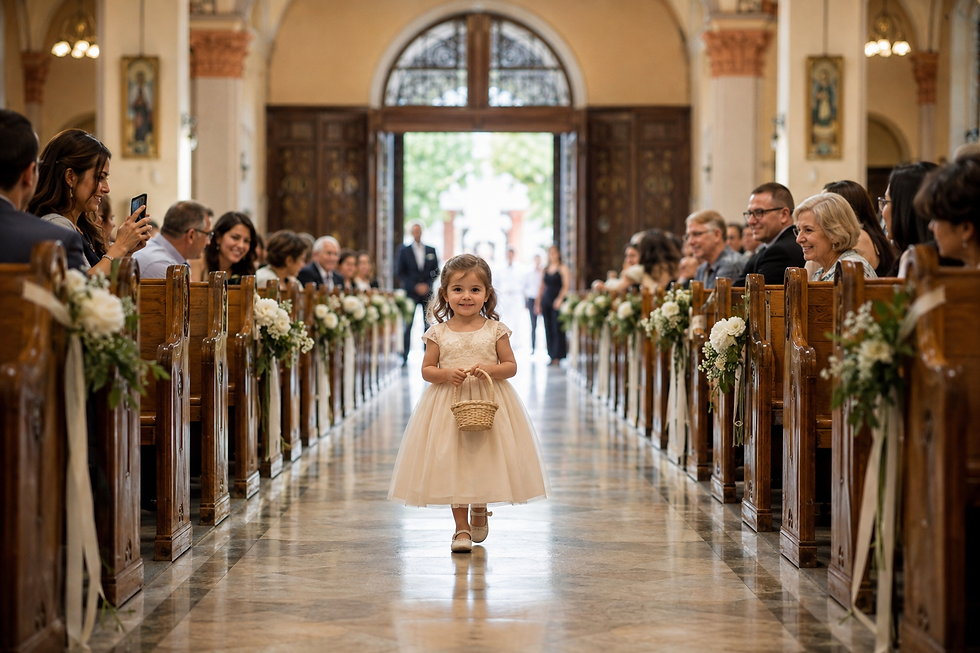
Usually right before the bride—they're often the charming final note before you appear. That said, parish procedures vary, and a few practical things are worth checking rather than assuming:
Some parishes have age recommendations for children in the procession.
Some prefer that very young children sit with a parent right after they process, so no one's stranded at the front.
Some churches don't permit scattered flower petals (they can be slippery, and cleanup is real).
The rings used during the exchange of vows may be handled according to the parish's instructions—sometimes kept by the best man or a server rather than entrusted to a small child's pillow.
None of these are universal Church laws; they're the kinds of sensible, local details a parish sets for itself. So rather than memorizing rules, just add them to your list of questions: May we include a flower girl and ring bearer? Are petals allowed? Where should the little ones go after they walk?
Do the Parents and Grandparents Walk Down the Aisle?
Often, yes—though "how" varies a lot by parish. The Catholic wedding parents processional is one of the most flexible pieces of the whole entrance. Here's the general shape:
Grandparents. Frequently seated during the prelude music, or included at the very beginning of the formal procession if you'd like to honor them that way.
The groom's parents. They may process in together, accompany their son, or simply be seated before the entrance begins.
The bride's mother. In a common American processional, she's often the last parent seated before the wedding-party procession starts—a small, lovely signal that the entrance is about to begin.
Both sets of parents. In the more explicitly liturgical entrance, both the bride and groom are accompanied by their parents, so all four process in with the couple.
As with everything else, parish custom varies considerably on parents and grandparents—so treat the above as options to confirm, not fixed assignments.
Catholic Wedding Processional Examples
Here are three simple lineups you can actually use as starting points.
Example 1: Familiar American Catholic Processional
Grandparents ↓ Groom's Parents ↓ Bride's Mother ↓ Groom / Best Man ↓ Bridesmaids + Groomsmen ↓ Maid of Honor ↓ Ring Bearer + Flower Girl ↓ Bride + Father
Your priest and liturgical ministers may enter separately from the sanctuary or be incorporated into the procession, depending on your parish.
Example 2: Bride and Groom Accompanied by Their Parents
Liturgical Ministers ↓ Priest / Deacon ↓ Wedding Attendants ↓ Groom + His Parents ↓ Bride + Her Parents
There's a quiet beauty to this one: two families, each accompanying a child they raised, bringing them forward to establish a new family together. It gently makes the point that a wedding joins not just two people but two households.
Example 3: Bride and Groom Enter Together
Liturgical Ministers ↓ Priest / Deacon ↓ Attendants / Witnesses ↓ Bride + Groom
This is less familiar to many American couples, but it can beautifully emphasize that the two of you are entering marriage together, side by side, from the very first step. As always, check whether your parish uses or permits this form before you set your heart on it.
What If Your Family Situation Doesn't Fit the "Traditional" Procession?
If the standard lineup assumes a family that doesn't quite match yours, there is no reason a complicated family structure has to make your church entrance uncomfortable. Real families are layered—divorced or remarried parents, a parent who has passed away, an estranged relationship, a beloved stepfather or stepmother, an adoptive or foster family, grandparents who raised you, a blended family with lots of people who matter. The procession can bend to hold your story. It's meant to.
Some possibilities couples use:
One parent escorts the bride.
Both biological parents walk her in together.
A parent and a stepparent share the honor.
A sibling walks alongside her.
A grandparent who helped raise her escorts her.
Another loved one—the person who's truly been there.
The bride enters alone, walking toward her groom on her own two feet.
The couple enters together, where the parish permits it.
There's no single choice you're "supposed" to make, and no arrangement here is more or less Catholic than another. If your family dynamics are delicate, one practical tip helps enormously: talk it through privately with your parish wedding coordinator or priest before the rehearsal. A quiet heads-up means the arrangement is already understood by the people running things, so the day itself carries no awkward surprises—just the people you love, in the places that feel right.
Does the Catholic Processional Change If You're Having a Nuptial Mass?
This is a common source of confusion, so let's untangle it. There are two forms of the rite: the Order of Celebrating Matrimony within Mass (a Nuptial Mass, with the full celebration of the Eucharist) and the Order of Celebrating Matrimony without Mass (a complete, valid Catholic wedding that doesn't include Mass, often chosen when one partner isn't Catholic). They do differ liturgically once things are underway.
But here's the key point for your processional question: the exact wedding-party lineup depends far more on parish practice than on whether you're celebrating within Mass or not. Choosing a Nuptial Mass doesn't automatically decide whether your dad escorts you, whether the groom walks down the aisle, or whether your parents process in. Those entrance details are set by your parish's custom, not by the Mass-or-no-Mass question. So don't assume one choice locks in the other—ask about the procession as its own topic.
(For more on the difference between the two, see our companion guide: Catholic Wedding Ceremony vs. Nuptial Mass: What's the Difference?)
Questions to Ask Your Church Before Finalizing the Processional
Bring this list to your planning meeting or rehearsal. Getting clear answers now is what turns wedding-day logistics from stressful into smooth:
Does our parish have a required or preferred processional order?
Where does the priest or deacon enter?
Do altar servers or a cross bearer process in?
Does the groom enter from the side, or walk down the aisle?
Can both sets of parents process?
Can my father escort me?
Can both of my parents escort me?
Where do grandparents enter or get seated?
Do bridesmaids and groomsmen walk together or separately?
Where do the maid of honor and best man enter?
Can we include a flower girl and ring bearer?
Are flower petals permitted?
Where does everyone stand or sit after processing?
Will we practice the entire entrance at the rehearsal?
When does the entrance music begin and change?
Is a separate bridal processional song permitted, or does the parish use one entrance hymn or piece?
What Happens at the Catholic Wedding Rehearsal?
Most of these details come together at the rehearsal, which is exactly what it's for. Typically, the rehearsal is when your wedding party learns:
where to line up
the exact processional order
pacing—how slowly to walk, when to start
where each person sits or stands
how the parents are seated
where the children go
the movements during the Rite of Matrimony itself
how the recessional works at the end
In other words, you don't have to have every step perfectly memorized ahead of time. The rehearsal exists to walk everyone through it together, so that on the wedding day your whole party moves with quiet confidence.
A Simple Catholic Wedding Processional Checklist
Here's the whole thing, boiled down to what you can mentally check off:
☐ Confirm your parish's processional rules
☐ Decide whether parents and grandparents will process
☐ Decide who escorts each member of the couple
☐ Finalize the wedding-party order
☐ Confirm flower girl / ring bearer details
☐ Confirm processional music with the parish musician
☐ Send the lineup to your wedding party
☐ Add roles and names to your wedding program, if desired
☐ Practice everything at the rehearsal
Don't Forget Your Wedding Program

Once your processional is set, there's one small step that pulls it all together: listing the members of your wedding party and their roles in your Catholic wedding program. It's a lovely keepsake, and it does real work on the day itself. A thoughtfully planned program helps your guests—especially those who aren't Catholic—understand what's happening after everyone reaches the front and the liturgy begins, so no one's left guessing when to sit, stand, or kneel.
Catholic Vows offers thoughtfully designed Catholic wedding programs created specifically around the structure of the Catholic liturgy, including options with guest guidance and sit-stand-and-kneel cues—so your program feels as intentional as the ceremony itself.
Frequently Asked Questions
What is the Catholic wedding processional order? There's no single, universal, detailed order required for every Catholic wedding. A common American example is: grandparents, the groom's parents, the bride's mother, the groom, the bridesmaids and groomsmen, the honor attendants, the ring bearer and flower girl, and finally the bride. Your parish may arrange it differently, so always confirm.
Does the groom walk down the aisle in a Catholic wedding? He may. In some parishes the groom enters from the side with the priest or waits near the sanctuary; in others he processes down the main aisle, or enters with his parents. Customs differ from parish to parish.
Does the bride have to walk down the aisle with her father? No. She may be accompanied by her father, both parents, her mother, another loved one, or she may walk alone—or enter with the groom where the parish permits it.
Can both parents walk the bride down the aisle in a Catholic wedding? Often, yes—and Catholic liturgical tradition especially supports both parents accompanying the couple, since the Order of Celebrating Matrimony describes a form in which the bride and groom are each accompanied by their parents. Confirm the specifics with your parish.
Can the groom walk with his parents? Yes, depending on parish practice. Having the groom accompanied by his parents is a recognized form of the Catholic entrance.
Do bridesmaids and groomsmen walk together in a Catholic wedding? They may walk in pairs or separately, depending on local custom. Sometimes the groomsmen are already at the front while the bridesmaids process individually.
Who goes first in a Catholic wedding procession? It varies. In a more liturgical arrangement, the ministers begin the procession; in a common American arrangement, family members are seated before the wedding-party procession starts.
Does the priest walk down the aisle? He may process in with the ministers, or he may already be at the sanctuary and enter from there—depending on the entrance arrangement and your parish's practice.
Who walks out first after a Catholic wedding? Usually the newly married couple leads the recessional, followed by their attendants and others. Exact recessional arrangements vary by parish, so there's no single universal order here either.
A Warm Word Before You Go
Take a breath—Start with your parish's practices, choose from the good options available to you, and let the rehearsal make sure everyone knows exactly where to go. Once your entrance is set, the rest of the Catholic wedding ceremony order will unfold naturally from there. That's really all it takes.
And when the music begins and you take that first step down the aisle, remember what you're actually walking into: not just a beautiful entrance, but the opening moments of your Catholic wedding liturgy—the very beginning of your marriage. Whoever is beside you, and whatever order your loved ones enter in, that walk is the first step of a life you're choosing together. It's going to be wonderful.
Planning Your Catholic Wedding?
From the processional to the final blessing, there are so many little details that come together to make a Catholic wedding feel both beautiful and deeply meaningful.
If you’re still planning your day, explore the Catholic Vows collection of editable Catholic wedding templates created specifically for Catholic couples—including detailed Mass programs, invitations, seating charts, signs, menus, and other coordinated wedding stationery.
Explore Catholic Wedding Mass Programs →Shop Catholic Wedding Invitation Suites →Browse Catholic Wedding Signs & Reception Details →
Each design is created to help you keep the beauty of your wedding day aligned with the sacred celebration at its heart.


Comments