Catholic Wedding Timeline: How to Plan Your Day Around the Mass

Updated: Aug 26

Most wedding timeline templates start in the same place: cocktail hour, then dinner, then dancing, all worked out backward from the reception.
Catholic brides usually have a different starting point. Before you can think about any of that, one piece of the day is often already decided for you: the church.
Your parish may have given you a specific ceremony time. Your wedding might be celebrated within a full Nuptial Mass, which usually runs longer than a short secular ceremony. Photography inside the church may be limited. Your reception venue might be clear across town. Suddenly a "simple" wedding timeline feels like a puzzle with a few fixed pieces you can't move.
Here's the reassuring part. It's absolutely manageable, and you don't need a planner's spreadsheet to figure it out. The trick is to stop building from the reception and start building from the parts that are already set. Begin with your parish schedule, then build outward. This guide will show you how, one piece at a time.
Start With the One Time You Usually Can't Move: Your Church Ceremony
Most couples don't have full freedom over when their ceremony happens. Parishes schedule weddings around a lot of things you may not see: a Saturday vigil Mass, another wedding earlier or later that day, scheduled times for Confession, parish events, or set wedding time blocks the office works within.
So the first thing to lock in, before you finalize anything else, is your exact ceremony time. That becomes the anchor for your whole day.
While you're talking to the parish, confirm a few other details at the same time, because they vary a lot from church to church and they'll shape your timeline:
How early your wedding party may arrive
How long you're able to stay afterward
Any photography restrictions inside the church
Whether another Mass or wedding follows yours
Whether there's a receiving line
Whether the parish expects the celebration to end by a certain time
A five-minute conversation with the parish office now saves a lot of guessing later.
How Long Should You Allow for a Catholic Wedding?
This is one of the most common questions, and an important one, because underestimating it throws off everything after.
A wedding celebrated within Mass generally takes longer than one celebrated without Mass. That's the big variable. Beyond it, the length depends on your music, the number of readings, the homily, any cultural or devotional traditions you're including, Communion, and the size of your wedding party and procession. Parish practices differ too.
As a rough planning range, many couples find a Nuptial Mass runs somewhere around an hour to an hour and a half, while a ceremony without Mass is often shorter. Please treat that as a starting point, not a promise. Your parish can tell you what's realistic for the way your wedding is being celebrated, and their answer is the one to plan around. Whatever you do, don't build your reception timeline on top of an unrealistically short ceremony estimate. Give the Mass room to be what it is.
Build Your Wedding Day Backward From the Mass
Once you know your ceremony time, the rest of your morning almost plans itself, as long as you work backward.
Say your Mass begins at 2:00 in the afternoon. Instead of asking "what time should hair start," ask a series of questions in reverse:
What time do we need to arrive at the church?
How long does it take to get there?
How much buffer do we want on top of that?
Do we want getting-ready or first-look photos before we leave?
What time does hair and makeup need to be finished to make all of that work?
You're walking the day in reverse: Mass start time, then arrival, then travel, then photos, then getting ready. Each answer sets the next. You don't need to nail down every minute yet. Right now you're just building the framework and making sure the pieces sit in order.
How Early Should You Arrive at the Church?
Arrival time varies more than people expect. Some parishes want the wedding party there quite early. Others have limited access beforehand because of other activities that morning, so you may not be able to get in as far ahead as you'd like. Confirm this with the parish directly rather than borrowing a number from a generic timeline online.
Whatever the specific time, arriving with a cushion matters. Those early minutes are when everyone gathers, when people find a restroom and do final touch-ups, when the procession gets organized, and when you and the clergy coordinate anything last-minute. If transportation runs late, that same cushion keeps a small hiccup from turning into a scramble before you walk down the aisle.
First Look or No First Look? How It Changes Your Timeline
There's no right answer here, and this isn't a nudge either way. It's simply a decision that affects how your photography fits into the day.
If you do a first look, you may be able to finish a good chunk of your photos before the ceremony: couple portraits, wedding party photos, and sometimes some family photos too. That can dramatically shorten what you need to squeeze in afterward.
If you'd rather not see each other beforehand, that's lovely too. You'll just want more photography time after Mass, which matters especially if there's significant travel between the church and reception, because those photos and the drive are competing for the same block of time. Either way, keep in mind that your church may have its own rules about where and when photos can be taken.
Plan Your Church Photos Before the Wedding Day
A lot of couples assume they'll be able to linger in the church afterward, taking photos at the altar for as long as they'd like. Sometimes that's true. Often it isn't.
Before the day, ask the parish whether posed photos are allowed after Mass, how much time you'll have, whether photos at the altar are permitted, whether another Mass or wedding follows yours, and whether the priest is available to be in photographs.
Then give your photographer those answers ahead of time. A good photographer can work beautifully within almost any set of church rules, but only if they know them before they arrive. Handing them the parish's expectations in advance is one of the simplest ways to protect your photo time.
The "Catholic Gap": What If Mass Ends Long Before the Reception?
This is the part that catches many Catholic couples off guard, so if you're worried about it, you're in very good company.
Here's the situation. Your parish gives you an early-afternoon ceremony time, but your reception venue doesn't come alive until evening. Mass wraps up mid-afternoon, cocktail hour doesn't start for hours, and now there's a noticeable gap in the middle of the day. Couples have nicknamed this the "Catholic gap," and it's extremely common.
First, take a breath. A gap does not automatically ruin your guests' experience. Plenty of weddings have one, and guests handle it just fine when they know it's coming. A few gentle ways to work with it:
Move cocktail hour earlier if your venue allows it
Start some reception activities sooner
Suggest a nearby café, hotel lobby, or spot where guests can relax in between
Arrange transportation if it makes sense for your group
Give out-of-town guests plenty of notice
Above all, tell everyone about the timing before the wedding day
That last point does most of the heavy lifting. Guests are remarkably relaxed about a gap when they've known about it for weeks. They get thrown only when it's a surprise on the day itself.
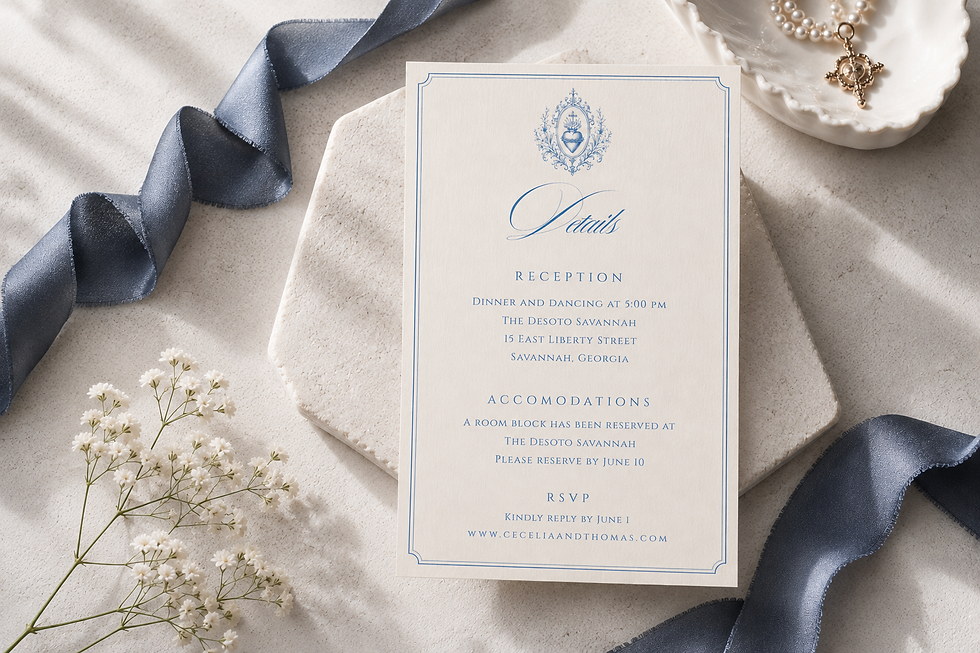
This is one of those moments where a clear details card or wedding website really earns its place. If your ceremony and reception aren't back to back, a simple, pretty card that lays out the timing lets guests plan their afternoon instead of standing in a parking lot wondering what happens next. If you'd like something that does exactly that, our Catholic Wedding Details Cards are made for it.
Don't Forget Travel Time Between the Church and Reception
Travel is probably the single most underestimated piece of a Catholic wedding timeline.
It's easy to glance at a map, see a fifteen-minute drive, and pencil that in. But the real door-to-door time is almost always longer. You have to load a whole wedding party into cars. There's traffic, parking, and the walk from the lot. Larger bridal parties move slowly. Shuttles have their own pace. Elderly guests need extra time. And in an unfamiliar city or a busy downtown near the church, everything runs slower than the app predicts.
The fix is easy: add a buffer on top of the ideal travel time rather than planning around the best-case number. Worst case, you arrive a few minutes early and get to catch your breath.
Where Do Family Photos Fit?
Family photos tend to expand to fill whatever time you give them, so it helps to decide in advance where they'll happen. You've generally got three options.
Before Mass works well if everyone's available early and you're comfortable seeing each other beforehand, often paired with a first look. Immediately after Mass is very common, though it depends heavily on how much time the church allows. And some family combinations, especially larger extended-family groupings, come together nicely at the reception venue instead.
Whichever you choose, make a short written photo list ahead of time. Deciding "okay, now grandparents, now just the siblings" on the fly eats up far more time than couples expect, and a quick list keeps things moving.
When Should Your Mass Programs Be Set Out?
Your programs should be ready and in place before guests start arriving, not handed out in a rush as people file in.
Depending on your parish, programs might be placed on the pews, displayed in a basket near the entrance, handed out by ushers, or set on a table by the doors. Ask the parish what they prefer, since some churches have a particular way they like this handled.
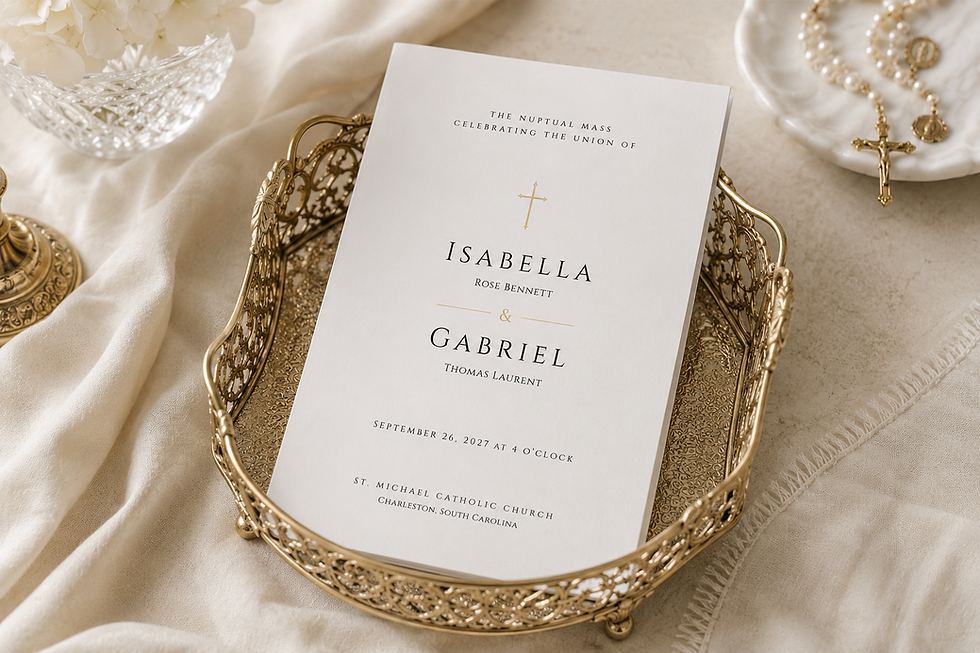
A well-designed program does more than look pretty, too. It quietly helps everyone follow along, which matters a great deal if some of your guests aren't Catholic and won't necessarily know when to stand, sit, or respond. If that's your crowd, our guide on having non-Catholic guests at your Catholic wedding is worth a read, and our Catholic Wedding Mass Programs are made to guide guests gracefully through the liturgy.
A Sample Catholic Wedding Day Timeline

Here's one example to help you picture how the pieces fit together. This is just an illustration, not the "correct" schedule. Your own timing will look different.
Example: 2:00 p.m. Nuptial Mass
Morning: Hair and makeup
Late morning: Getting-ready photos
Early afternoon: Travel to the church
1:15 p.m.: Wedding party arrives
2:00 p.m.: Nuptial Mass begins
Around 3:00 p.m.: Family and church photos
3:30 p.m.: Travel and any additional portraits
5:00 p.m.: Cocktail hour
6:00 p.m.: Reception
Notice it isn't packed with precise, minute-by-minute detail. That's on purpose. Your actual timeline depends on your parish's schedule, your photography plan, how far your reception is, and when your venue opens. Use this to see the shape of the day, then build your own version around your real numbers.
The Most Common Catholic Wedding Timeline Mistakes
A few slip-ups come up again and again, and none are hard to avoid once you know to watch for them:
Assuming the Mass will take thirty minutes. A full Nuptial Mass usually runs longer, and a too-short estimate throws off everything after it.
Forgetting the parish may limit photos after Mass. Counting on a leisurely altar session the church doesn't allow leaves your plan scrambling.
Not allowing enough travel time. The real door-to-door time is almost always longer than the map says.
Telling guests only the ceremony and dinner times. If there's a gap and no one explained it, guests are left guessing.
Planning hair and makeup forward instead of backward. Start from your church arrival time and work back.
Not giving your vendors the church's rules. Photographers can work within any guidelines, but only if they know them in advance.
Cramming too much into the hour before Mass. That final stretch fills up fast, so protect it.
Building in no buffer at all. A day with zero cushion feels rushed from the very first hour.
What Should Guests Know Before the Wedding Day?
So much of a smooth timeline comes down to communication. Half the problems on that list disappear when guests simply know what to expect before they arrive.
Depending on your day, guests may need the church address, the reception address, where to park, the ceremony and reception start times, whether there's a significant gap in between, any transportation details, and what to wear if that's relevant.
You don't have to cram all of it onto one card. Between your invitation suite, a details card, and your wedding website, there's plenty of room to lay it out clearly. The point is just that the information reaches your guests ahead of time, so no one's texting a cousin from the parking lot trying to figure out where to go.
Build in More Breathing Room Than You Think You Need
Wedding days almost never run with stopwatch precision, and that's completely normal. Hair runs a little late. Someone forgets a boutonnière. Traffic does what traffic does. Family photos take longer because everyone wants to hug the bride first. None of these are disasters. They're just the ordinary friction of a big, joyful day with a lot of people in motion.
The couples who feel calm on their wedding day aren't the ones who timed everything perfectly. They're the ones who left a little margin in a few key places, so a five-minute delay stays five minutes instead of cascading into the next hour. When in doubt, pad it.
Let Your Timeline Serve the Sacrament, Not Rush It
It's easy to pour all your planning energy into the reception, making sure dinner is served on time and the dancing starts on cue. That matters. But the church ceremony isn't a box to check between hair and cocktail hour. It's the reason for the whole day.
So give the Mass the space it deserves. Plan carefully enough on both sides of it that you're not quietly watching the clock during your own wedding, wondering whether you're running behind. You want to be fully present for the vows, the readings, and the Eucharist. A good timeline handles the logistics in the background so the sacred part gets your full attention.
A Few Things to Finalize Before Wedding Week
As the wedding gets close, a short checklist to make sure the timeline holds together:
Confirm your ceremony time with the parish
Confirm your arrival time
Confirm the church's photography rules
Confirm transportation, if you're arranging any
Give your final timeline to your photographer and videographer
Make sure your Mass programs are finalized and printed
Make sure guests know about any significant schedule gap
Confirm your reception timing with the venue
Cross those off and you can head into your wedding week trusting the pieces are in place.
Planning the Catholic Details Doesn't Have to Feel Complicated
Catholic weddings come with a handful of planning details that don't always show up on the generic checklists, and that's why Catholic Vows Co exists to serve with beautiful templates to help you plan your special day with ease.
Everything we make is designed around the real rhythm of a Catholic wedding, from the invitation to the last sign at the reception. The pieces that tend to matter most for your timeline are the ones that keep everyone informed and help the day feel considered: invitation suites, details cards, Mass programs, church and reception signage, and seating charts. All of it is elegant, editable in Canva, and made specifically with Catholic couples in mind.
If you'd like to see what might fit your day, come explore our Catholic wedding stationery. There's no rush. It'll be there when you're ready.

A Timeline That Lets You Actually Enjoy the Day
If you started this article feeling a little overwhelmed by your church time and everything that has to happen around it, I hope you're breathing easier now.
The best Catholic wedding timeline isn't the one that looks flawless on paper. It's the one that respects your parish's schedule, gives the Mass enough room, leaves time for photos and travel, keeps your guests in the loop, and still lets you and your future spouse enjoy the day you've been dreaming about.
Start with your church time. Build outward. Leave a little margin. You've got this!

Comments