Catholic Wedding Mass Program: What to Include + Complete Order
Updated: Aug 26
You said yes, you set the date, and somewhere between choosing your readings and confirming your cantor, you realized your wedding program is going to need more than two names and a Bible verse. A Catholic wedding program has to hold readings, prayers, music, responses, the names of everyone standing up with you, and the quiet rhythm of a liturgy that most of your guests can't be expected to know by heart. If you've been staring at a blank page wondering how any of this fits into one elegant little booklet, you're in exactly the right place, and you're not behind.
A Catholic wedding program is a different creature than the single-page program you might see at a secular ceremony. It isn't just a nice keepsake with your names on the cover. When you're marrying within a Nuptial Mass, your program is quietly doing two jobs at once. It keeps the ceremony organized and beautiful, so the flow feels intentional rather than improvised. And it helps every guest in the pews, Catholic or not, follow what is happening and why it matters.
One thing to keep in mind before we go any further: every parish does things a little differently. The general structure of a Catholic wedding is consistent, but the specific readings, customs, and wording should always be confirmed with your priest or parish. Think of this article as a map of the territory, not the final route your celebrant will walk you through.
Do You Need a Program for a Catholic Wedding Mass?
Let's clear this up right away, because it's a common worry. A program is not required for your marriage to be valid. You will be just as married with or without a beautifully printed booklet in every pew. So if anyone has made you feel like this is one more non-negotiable on the list, breathe.
That said, a Catholic wedding program earns its place at certain weddings more than others. It's especially helpful when you're celebrating a full Nuptial Mass, since there's simply more happening than in a ceremony without Mass. It's a gift when many of your guests aren't Catholic and won't know the responses or the postures. It's practically essential to have a bilingual Mass Program for a bilingual wedding, where guests may be following along in two languages. And it does real work when your ceremony includes multiple readings and music selections that guests would otherwise have no way to anticipate.
Beyond the liturgy itself, a program lets guests know when to sit, stand, and kneel without anyone feeling caught off guard, and it gives you a graceful place to name the people participating, from your celebrant to your readers to the wedding party.
A thoughtfully designed program can make a traditional liturgy much easier for guests to follow without ever distracting from the Mass itself. That's the goal: not to explain everything, but to help everyone feel included in something sacred.
What Should Be Included in a Catholic Wedding Mass Program?

Here's the honest answer most brides are looking for: there are a handful of categories nearly every Catholic wedding program covers. You don't have to include every single element, and you'll make choices along the way, but these are the building blocks.
Cover
Your cover sets the tone before anyone reads a word. Most couples include their names, the wedding date, the name of the church or parish, and the city. Many also add a title that names the occasion, something like "The Sacrament of Holy Matrimony" or "The Nuptial Mass of," followed by your names.
If you're unsure which phrasing your parish prefers, it's worth a quick confirmation. Some parishes have a house style for how the sacrament is named, and it's an easy thing to get right when you simply ask.
Wedding Party and Liturgical Participants
This is where you honor the people walking this day with you. Depending on your ceremony, you might list your celebrant, your parents, your maid or matron of honor, your best man, your bridesmaids and groomsmen, your lectors or readers, your gift bearers, and your musicians or cantor.
You don't have to name every person who touches the day. Some couples keep this section warm and full; others keep it streamlined. It's genuinely your call, and there's no wrong way to do it as long as it feels like you.
Understanding the Structure of a Catholic Wedding Mass
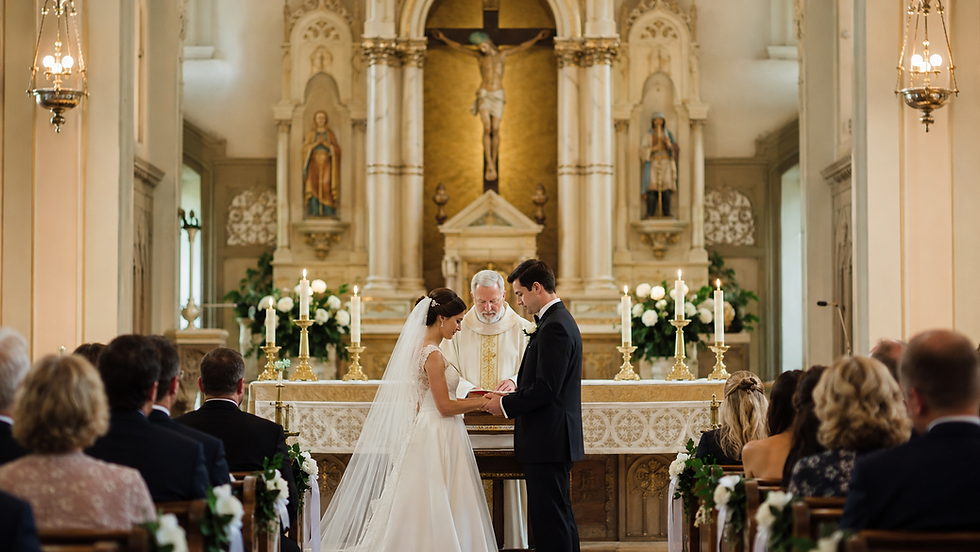
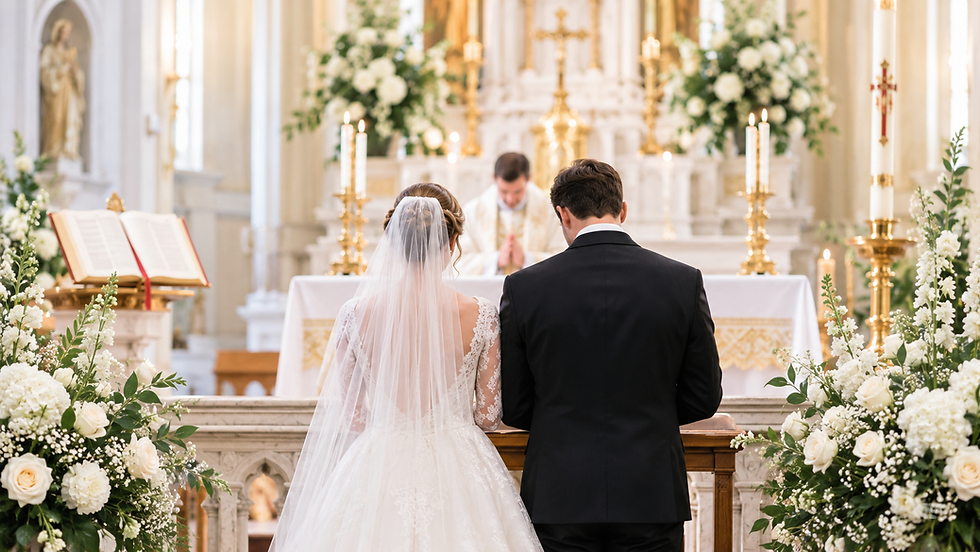
A wedding celebrated within Mass generally moves through five major parts: the Introductory Rites, Liturgy of the Word, Celebration of Matrimony, Liturgy of the Eucharist, and Concluding Rites.
Within those sections are the readings, vows, exchange of rings, prayers, Eucharistic liturgy, Communion, and final blessing that make up the celebration.
One important note to hold onto: the exact order can vary depending on your parish, the choices you make with your priest, and whether Matrimony is celebrated within Mass or without Mass. Always treat your parish-approved ceremony plan as your final authority. If something here differs from what your celebrant gives you, follow your celebrant.
Should You Include Sit, Stand, and Kneel Cues?
If there's one small feature that makes an outsized difference for guests, it's posture cues. A simple, elegantly placed Stand, Sit, or Kneel beside the right moment can quietly rescue a guest who has no idea what's coming next.
These cues matter most when many of your guests aren't Catholic, when your wedding is bilingual, or when a good number of people simply aren't familiar with the rhythm of the Mass. Instead of glancing nervously around the church to see what everyone else is doing, a guest can follow along with confidence and stay present in the moment with you.
Conceptually, this is as light as a small Stand, Sit, or Kneel marker placed where it's needed. The trick is doing it beautifully. A program that's cluttered with cues everywhere becomes hard to read and loses its elegance. A thoughtfully formatted program can weave these cues in cleanly, so the pages still feel calm and refined while guests get exactly the guidance they need.
What About Non-Catholic Guests?
This is the worry I hear from brides more than almost any other, and it deserves real attention. You love your family and friends, and the thought of them sitting through your wedding feeling lost or unsure is genuinely uncomfortable. Especially if your fiancé, or a large share of your guests, isn't Catholic.
A program can be so gentle here. It can identify the parts of the Mass as they unfold, so guests understand the arc of what's happening. It can include those posture cues we just talked about. It can briefly explain a few unfamiliar moments so nothing feels mysterious or exclusionary. And, where it's appropriate and approved by your parish, it can offer respectful guidance around Communion, so non-Catholic guests know what's customary and never feel put on the spot.
There's a lot that can be said to help guests feel welcome, and some couples decide they want a more detailed program that includes fuller guidance for guests who are new to the Mass. If that's a priority for you, it's worth thinking through how much explanation belongs in the program itself versus a companion piece. (If you'd like to go deeper on this, our guide on the Catholic Wedding Mass for non-Catholic guests walks through it in more detail.)
Should You Include the Full Readings and Prayers?
Here's a decision every couple faces, and there's no single right answer. Some brides picture a fuller booklet with the readings printed in full so guests can read along. Others prefer something lighter and more elegant.
Printing full readings and prayers makes for a longer booklet, and it isn't always necessary. Plenty of couples choose to list only the titles and Scripture references, which keeps the program slim and refined while still telling guests exactly what's being proclaimed. Others include selected text, and some do go for the more complete booklet.
The right choice really depends on the style of program you want and what your parish prefers. A shorter, reference-only program feels crisp and modern-classic; a fuller booklet feels more like a keepsake. Knowing which direction you're leaning will also help you choose the right template length, since a program built for references is laid out differently than one built to hold full readings.
What Else Can Go in the Program?
Once the essentials are in place, there's room for the personal touches that make the program feel like yours. Couples often include a short thank-you note to guests, a memorial section remembering loved ones who have passed, a brief explanation of Catholic marriage for guests who'd appreciate the context, a wedding photo, or a meaningful Scripture verse that has carried the two of you.
Some couples add the names of deceased family members they're holding close that day, and bilingual couples often weave in a second language so no one is left out. These are the details that turn a functional program into something guests tuck into a keepsake box, so choose the few that matter most to you rather than trying to fit them all.
Before You Print: Confirm These Details With Your Parish
Before anything goes to the printer, run through a quick check with your parish. It saves you from reprinting and, more importantly, from wording something in a way your celebrant wouldn't. Confirm the final liturgical order, your chosen readings, and the names and titles of the clergy who'll be celebrating. Confirm your music selections, the liturgical participants you're naming, and any optional customs you hope to include.
If your program offers Communion guidance, confirm the wording with your parish, and ask about any parish-specific requirements while you're at it. A template makes the formatting effortless, but it doesn't replace your parish's guidance, and no template ever should. Your priest is the one who makes the ceremony official; the program just makes it beautiful and easy to follow.
The Easiest Way to Create Your Catholic Wedding Mass Program

Once your priest or parish has helped you finalize the ceremony, the next step is simply bringing all of those details together in a clear, beautiful program.
That’s where a thoughtfully designed template can make things much easier. Catholic Vows Co. Mass program templates are created specifically for Catholic wedding ceremonies, so the structure of the Mass is already considered from the beginning. Rather than starting with a blank page, you can open the template in Canva and personalize it with your own names, readings, wedding party, music, and ceremony details.
The programs are designed to feel elegant and wedding-ready while still keeping the liturgy easy for guests to follow. Some options also include sit, stand, and kneel guidance, along with standard and bilingual formats for couples who want a little extra help guiding their guests through the Mass.
The goal is simply to give you a beautiful starting point so you can spend less time formatting and more time focusing on the details that are meaningful to your wedding.
Final Thoughts
Your wedding program doesn’t have to explain every detail of the Mass. Its purpose is simply to help your guests follow along with greater confidence while preserving the beauty and reverence of the liturgy.
Once your priest or parish has helped you finalize the ceremony order, readings, music, and any parish-specific customs, you can turn your attention to how you want those details presented. That part can be simple, thoughtful, and beautiful.
A well-designed program should feel like a natural extension of the day itself — clear enough to guide your guests, elegant enough to complement your wedding, and reverent enough to honor the Sacrament of Matrimony.
When you’re ready to bring it all together, you can browse the Catholic Vows Co. Mass program collection and choose a design that fits your ceremony, your style, and the celebration you’re preparing for.

Comments