Catholic Wedding Music Guide: What to Play for the Processional, Mass & Recessional

You've picked the church. You've chosen your readings. And then someone hands you the music-planning sheet, and suddenly you're staring at a page full of blanks:
Prelude. Processional. Responsorial Psalm. Offertory. Communion. Marian Devotion. Recessional…
And you're thinking: Wait — how many songs do we actually need?
And underneath that, the question almost every Catholic bride is quietly wondering: What am I supposed to walk down the aisle to?
If that's you, take a breath. You're not behind, and you haven't missed some obvious memo that everyone else received. Catholic wedding music genuinely works a little differently from the music at a reception or a movie wedding, and most brides — even lifelong Catholics who love their faith deeply — have never had a reason to learn how it all fits together until now.
So let's sort it out together, calmly, from beginning to end. This guide will walk through a Catholic wedding from the first prelude note to the last joyful chord and explain:
where music actually happens
what each piece is doing
beautiful possibilities worth considering
what changes when there's a full Nuptial Mass versus a ceremony without Mass
and what needs your parish's approval before it's final
And ideally, choosing it becomes one of the loveliest parts of planning your liturgy rather than one of the most confusing.
One honest note before we begin, and it's an important one. There is no single master list of "songs allowed at Catholic weddings" that applies identically everywhere. Dioceses, parishes, pastors, and music directors each have their own guidelines, and a piece welcomed warmly at one parish may not be approved at another. So throughout this guide, when we name specific music, treat it as a beautiful option to ask your music director about — never as a guarantee. Your own parish always has the final word on your specific plan. We'll say that more than once, because it really does matter.
First — How Does Music Work at a Catholic Wedding?
Here's the single idea that explains almost everything else: a Catholic wedding is a liturgy, not simply a ceremony that happens to take place inside a church.
That distinction sounds small, but it changes everything downstream. At a liturgy, music isn't a soundtrack playing behind the action. It's part of the prayer. It helps everyone present — you, your fiancé, your families, the whole assembly — actually pray and take part in what's happening. That's why the Church cares about what music is chosen, and why the planning sheet has more on it than "pick a pretty song for your entrance."
This is not about making weddings solemn in a joyless way, or about preventing you from expressing who you are as a couple. It's the opposite. It's about choosing music worthy of what is actually taking place: two people entering the covenant of marriage before God and His Church. The beauty of your music isn't being restricted — it's being pointed at something even greater than itself.
And here's the most practical thing in this entire guide: before you fall in love with any particular processional, ask your parish for its wedding music guidelines.
Many parishes provide some or all of the following:
an approved or recommended music list
their required or preferred musicians (organist, cantor)
specific restrictions or things they don't permit
the Mass setting they use
information on the music-planning meeting
rehearsal details and deadlines
Getting that sheet first saves so much heartache. It's a lot easier to choose a processional you love from within your parish's guidelines than to fall head-over-heels for one particular piece and then learn it doesn't fit. Think of the guidelines not as a fence but as the shape of the beautiful thing you're building.
What Music Do You Actually Need for a Catholic Wedding?
Let's give you the whole map. The honest answer to "how many songs do we need?" is: fewer than the blank lines make it look like, and some of them aren't yours to choose at all — the music director or cantor handles a good number of them.
There are two versions of the map, depending on whether you're having a full Nuptial Mass or a wedding ceremony without Mass.
A Catholic Wedding With Mass (Nuptial Mass)
Here are the moments where music may appear, in order. Read this as a landscape, not a to-do list — you will not be personally selecting a distinct "song" for every single line.
Moment | What's happening | Who usually decides |
Prelude | Music as guests arrive and settle into prayer | Often the musicians |
Processional (wedding party) | The attendants and family enter | You + music director |
Bride's entrance | Your walk down the aisle | You + music director |
Gloria (when prescribed) | A hymn of praise, part of the Mass | The Mass setting / parish |
Responsorial Psalm | Sung response within the Liturgy of the Word | Cantor / music director |
Gospel Acclamation (Alleluia) | Greeting the Gospel | The parish musicians |
Preparation of the Gifts (Offertory) | Gifts brought to the altar | You + music director |
Holy, Holy, Holy (Sanctus) | Part of the Eucharistic Prayer | The Mass setting |
Memorial Acclamation | Part of the Eucharistic Prayer | The Mass setting |
Great Amen | Concludes the Eucharistic Prayer | The Mass setting |
Lamb of God (Agnus Dei) | Before Communion | The Mass setting |
Communion | Accompanies the Communion procession | You + music director |
Marian devotion (where customary/approved) | A moment of prayer to Our Lady | Optional; ask your parish |
Recessional | You leave the church as husband and wife | You + music director |
Notice how much of that middle column already belongs to the parish. The Gloria, the Psalm setting, the Alleluia, and the four Mass parts (Holy, Memorial Acclamation, Great Amen, Lamb of God) are typically drawn from a single Mass setting the parish already uses — more on that below. That would be enough to ease a brides worry.
Also note: not every parish structures the entrance the same way. Some use an entrance hymn sung by the assembly; some accompany the procession with instrumental music; some do a blend. There's no one universal Catholic entrance choreography, so this is exactly the kind of thing to ask about rather than assume.
A Catholic Wedding Without Mass
When a couple marries without a Nuptial Mass, for example when one spouse is not Catholic — the celebration includes the Introductory Rites, the Liturgy of the Word, the actual Celebration of Matrimony (the consent and rings), the Nuptial Blessing, and a concluding rite. What falls away is the Liturgy of the Eucharist — the Offertory, the Eucharistic Prayer, and everything tied to Communion (unless Communion is distributed, which is sometimes done even without a full Mass).
Here's the simplified map:
Moment | With Mass | Without Mass |
Prelude | ✅ | ✅ |
Processional & bride's entrance | ✅ | ✅ |
Gloria | ✅ (when prescribed) | — usually omitted |
Responsorial Psalm | ✅ | ✅ |
Gospel Acclamation | ✅ | ✅ |
Offertory / Preparation of Gifts | ✅ | — (no Liturgy of the Eucharist) |
Holy / Memorial Acclamation / Great Amen / Lamb of God | ✅ | — |
Communion | ✅ | Only if Communion is distributed |
Marian devotion | ✅ (optional) | ✅ (optional) |
Recessional | ✅ | ✅ |
So a wedding without Mass has meaningfully fewer musical moments to plan, while keeping the ones brides care about most: the prelude, the processional, your entrance, the Psalm, a possible Marian devotion, and the recessional.
If you're still deciding between the two, or you're not sure which one your situation calls for, our guide on the difference between a Catholic wedding ceremony and a Nuptial Mass walks through it gently.

What Can a Bride Walk Down the Aisle to at a Catholic Wedding?
There are many beautiful possibilities — and your parish must approve the final choice.
You are not limited to one single, universal "Catholic bridal processional." There's no rule that every Catholic bride must enter to the same piece. What the Church asks is that the music be sacred and appropriate to the liturgy, and your parish music director helps you land in that range. Within it, you have real freedom and lots of gorgeous options.
It might be helpful to first organize by the feeling you want. You probably already know the mood you're after even if you don't yet know the names of the pieces.
If you want something timeless and elegant
These are the pieces that feel like a wedding the moment they begin — poised, gracious, unmistakably "church."
Canon in D — Pachelbel. Perhaps the most beloved processional of all: gentle, building, warmly familiar without being overdone in a sacred setting.
Jesu, Joy of Man's Desiring — J.S. Bach. Flowing and radiant, with a genuinely prayerful character. A favorite for good reason.
Air (from Water Music) — Handel, or Air on the G String — Bach. Serene, unhurried, deeply elegant.
Traditional trumpet voluntaries — such as the Prince of Denmark's March (often called the Trumpet Voluntary) by Jeremiah Clarke, or a trumpet voluntary by John Stanley. Bright and stately.
If you want something grand and majestic
Some brides want the doors to open and the whole church to rise. If that's you, look toward pieces that feel regal, soaring, and cathedral-like — dramatic without tipping into theatrical.
Prince of Denmark's March (Trumpet Voluntary) — Clarke, especially with organ and trumpet: pure processional splendor.
Rondeau — Jean-Joseph Mouret, the "Masterpiece Theatre" fanfare — instantly grand and celebratory.
Prelude from the Te Deum — Charpentier, or a festive trumpet tune: soaring and ceremonial.
These are especially glorious in a large church on a good organ with a trumpet. If your parish has that instrument, ask what shows it off best.
If you want something soft and prayerful
Maybe you don't want a fanfare. Maybe you want to walk into a quiet, minimal and holy feeling . Then look toward music that's intimate, reverent, and gentle:
Jesu, Joy of Man's Desiring — Bach (it works beautifully in this register too)
Air on the G String — Bach
Arioso — Bach
a tender organ or string setting your music director can suggest
There's something deeply moving about entering to music that already sounds like a prayer.
If you want something Marian
If your heart is set on Our Lady being part of your entrance, one gentle piece of wisdom: Marian music — including the Ave Maria — is often better suited to a Marian devotion later in the liturgy than to the bride's processional itself. It's not that it's forbidden as a processional; it's that a hymn to Mary can feel more at home in a moment set aside for prayer to her (more on that in the Ave Maria section below). This is a lovely thing to talk through with your music director, who can help you decide whether Our Lady belongs at your entrance or at a quiet devotion after Communion.
If you want something very traditional
Here's where we have to be honest and a little careful, because "traditional wedding music" can mean two different things. There's Catholic liturgical tradition — centuries of sacred music written for worship — and there's the cultural tradition of weddings that comes mostly from opera, film, and the wider culture. They overlap sometimes, but not always. The most famous example is "Here Comes the Bride," which we'll take on directly in its own section below.
Does the Bride Get Her Own Processional Song?
Often, yes — but not universally.
Some parishes give the bride a separate piece for her entrance, distinct from the music that accompanied the wedding party. Others use one continuous processional for everyone, or an entrance hymn sung by the assembly, or a local custom all their own. So the real answer is: ask your parish, because this genuinely varies from church to church.
If you do get a separate piece, here's a small planning tip that makes a big difference: think about how it transitions from the attendants' music. The two pieces should feel intentional together, not like an abrupt channel change. A good music director can make the handoff feel seamless — the wedding party's music resolving, a breath, and then your entrance rising. When it's planned well, that moment when the music shifts and the doors open is one of the most beautiful of the whole day.
Can I Walk Down the Aisle to "Here Comes the Bride"?
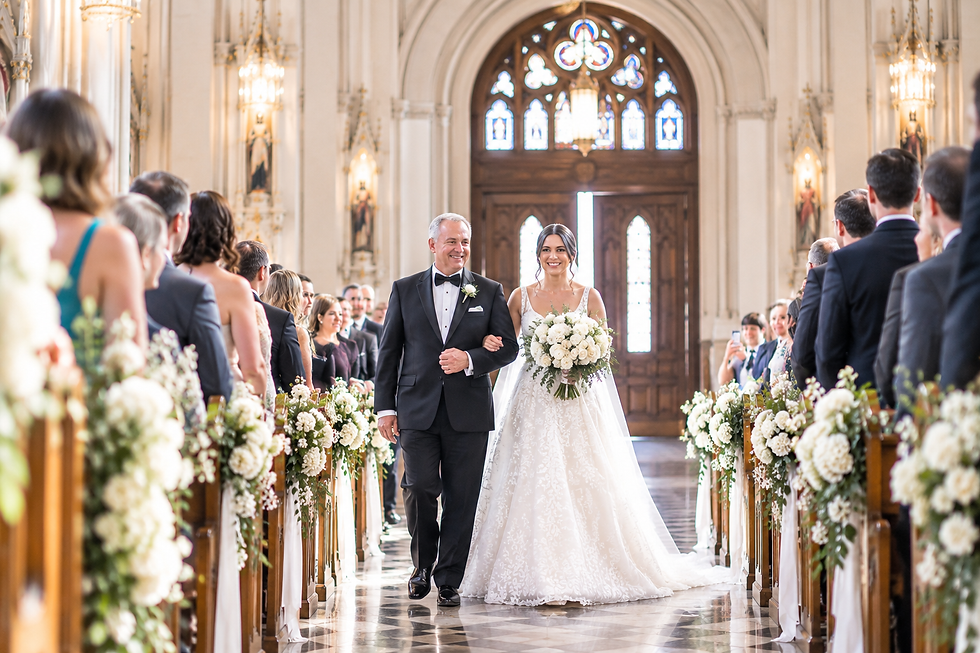
This is such a common question, and it's a completely understandable one — that tune is practically shorthand for "wedding." So let's give it a real answer.
"Here Comes the Bride" is the Bridal Chorus from Richard Wagner's opera Lohengrin (1850). Here's the part most people don't know: in the opera, it isn't a processional to an altar at all. It's sung after the wedding, as the bridal party escorts the couple to their chamber — and the marriage in the story promptly falls apart. It's a piece of theater, not a piece of sacred music.
For that reason, many Catholic parishes do not permit or recommend it. The usual concerns are that it's operatic and theatrical rather than liturgical, that it was never written for worship, and that its heavy use in film and television has attached it to sentiment rather than sacred prayer. Some dioceses have said plainly that it's "not to be used."
That said — and this is exactly why we keep pointing you back to your parish — policies genuinely vary. Some Catholic parishes do include the Bridal Chorus among their options. So the honest answer isn't a universal "no"; it's "many parishes decline it, some allow it, and yours will tell you which it is." Ask your music director rather than assuming either way.
And if your parish is one that sets it aside, please don't feel deflated. This is the heart of how we hope you'll experience all of this: whenever an answer might disappoint you, there's something beautiful waiting to be chosen instead. A Clarke trumpet voluntary, Pachelbel's Canon, a Charpentier prelude — any of these can give you the exact grand, "here she comes" moment you're picturing, with music actually written to lift hearts toward God. You're not losing the moment. You're giving it even better music.
Can I Use a Secular Song at My Catholic Wedding?
This one deserves real space, because it's where the most heartfelt questions live. Brides ask, sincerely and often:
Can I walk down the aisle to "Can't Help Falling in Love"?
What about "A Thousand Years," or "Perfect"?
What if it's just an instrumental piano version?
Could we use that piece from the movie?
If you've wondered any of these, you're in good company with many other brides. These are meaningful songs, tied to real memories, and wanting them at your wedding comes from a good and loving place.
Here's the key distinction, offered gently. Turning a secular love song into an instrumental doesn't automatically make it liturgical music. It's an understandable assumption — take out the lyrics, and what's left is just pretty notes, right? But lyrics aren't the only thing being considered. The music itself carries associations and a character, and the question the Church asks is whether this music, at this liturgical moment, helps the assembly pray and fits sacred worship. A pop ballad, even beautifully rendered on piano or strings, usually still sounds and feels like what it is — and most parishes will gently reserve it for a different part of the day.
And that's the reassuring part: you almost certainly don't have to give up the song you love. You may simply be giving it a different, and often better, moment. Parishes very commonly welcome those meaningful songs at the:
reception
first dance
cocktail hour
dinner
wedding video and getting-ready playlist
Picture it: instead of "Can't Help Falling in Love" passing by in ninety seconds as you walk, it becomes your first dance — the two of you, married, held close, with everyone watching. That song probably lands more powerfully there than it ever could as a processional. You're not losing it. You're placing it where it can shine.
As always, your parish and music director have the final say on what fits the liturgy — so ask. But go in knowing the goal isn't to take your favorite song away. It's to give the sacred moments sacred music, and let your love songs have their own beautiful spotlight later in the day.
Prelude Music — What Plays While Guests Arrive?
The prelude is the music playing as your guests arrive and find their seats, before the liturgy formally begins. Its job is quiet but important: it settles everyone, hushes the chatter, and gently establishes a prayerful atmosphere so that when the wedding starts, hearts are already turned toward God.
A few things that take the pressure off:
The prelude is usually several pieces, not one — often ten to twenty minutes of music.
The musicians typically select much of it themselves, from the sacred and classical repertoire they know suits the room and the organ.
So no, you probably don't need to hand-pick every prelude piece. You can, if you have favorites — but you don't have to.
If you'd like a sense of what you might hear, think along the lines of Bach's Air on the G String, Pachelbel's Canon in D, Handel's Air from the Water Music, or gentle organ repertoire. If you have two or three pieces you'd especially love woven in, tell your music director; otherwise, it's completely fine to say, "We trust you — please choose lovely prelude music." That's one less blank to agonize over.
Wedding Party Processional Music
This is the music that carries your family and attendants into the church. Who enters during it, and in what order, varies by parish custom — there is no single universal Catholic entrance choreography — but it commonly includes some arrangement of:
grandparents and parents (sometimes seated during the prelude, sometimes processed in)
the groom and best man (sometimes already at the front, sometimes entering here)
bridesmaids and groomsmen
the flower girl and ring bearer
Then the music transitions to your entrance. Because customs differ so much — some parishes seat family during the prelude, some make the mothers' entrance its own small moment with its own music — this is a great thing to walk through with your parish so the flow feels planned rather than improvised.
For the music itself, match it to the mood you want for the whole entrance. Something like a Clarke trumpet voluntary sets a bright, celebratory tone; Pachelbel's Canon or Bach's Jesu, Joy creates a warmer, flowing feel; a gentle Bach Air keeps things soft and reverent. Many couples use one piece for the wedding party and then shift to something a little grander for the bride — which brings us to the main event.
Bride's Processional
Here's a fuller set of possibilities for your walk down the aisle — genuinely useful ones, with a sense of what each actually sounds like, so you can picture yourself in the moment. Every one of these is a lovely option to bring to your music director; none is a guarantee, since your parish approves the final choice.
Canon in D — Pachelbel. The classic. It starts simply and gathers warmth as it goes, so it seems to swell right as you appear. Works beautifully on organ, strings, or both. Familiar, tender, timeless.
Jesu, Joy of Man's Desiring — J.S. Bach. Flowing, radiant, and genuinely prayerful — the melody rides over a gentle rolling accompaniment. Feels joyful and holy at once. Gorgeous on organ, and lovely with strings.
Trumpet Voluntary / Prince of Denmark's March — Jeremiah Clarke. The grand one. Regal, bright, and processional to its core, especially with organ and trumpet. If you want the doors to open and the church to rise, this is your piece.
Trumpet Voluntary in D — John Stanley. In the same stately family as the Clarke, a little different in character — ceremonial and dignified, wonderful for a majestic entrance.
Rondeau — Jean-Joseph Mouret. Instantly recognizable and unabashedly grand, with a fanfare that feels like an announcement. Celebratory and confident.
Air (from Water Music) — Handel. Serene and elegant, unhurried, with real nobility. For the bride who wants grace over grandeur.
Air on the G String — J.S. Bach. Soft, intimate, and prayerful — a slow, singing line that feels like walking into a hush. Beautiful when you want tenderness rather than a fanfare.
Arioso — J.S. Bach. Gentle and lyrical, with a quiet dignity. Another lovely choice for a soft, reverent entrance.
Rigaudon — André Campra. Bright, buoyant, and festive — a joyful baroque dance that lifts the whole room. A slightly less common pick, which some brides love precisely because it feels a little more theirs.
Prelude from the Te Deum — Marc-Antoine Charpentier. Soaring and ceremonial, built on a triumphant fanfare. Grand and unmistakably celebratory — a beautiful "here she comes" without being borrowed from opera.
Instrument matters more than couples expect. A trumpet voluntary is thrilling with a real trumpet and organ, and can feel a bit thin without them; a Bach Air is exquisite on strings. Ask your music director what your parish's instruments and musicians do best — the same piece can feel like a different experience depending on who's playing it and on what.
Responsorial Psalm
The Responsorial Psalm is easy to misread as "a little song between the readings," but it's more than that: it's part of the Liturgy of the Word, sung right after the first reading. Where possible, it's genuinely sung rather than read, and the whole assembly takes part through the repeated response. It's a moment where everyone prays a psalm together — often one of the beautiful marriage-friendly psalms like Psalm 128, Psalm 33, Psalm 34, Psalm 103, or Psalm 145.
Because it's a sung liturgical text with a specific structure, your cantor and music director usually provide the setting. You typically don't need to go find a "psalm song" on your own; you choose from the psalm options offered for weddings, and the musicians handle how it's sung. This connects naturally to the rest of the Liturgy of the Word — if you're still choosing your Scripture passages, our Catholic wedding readings guide walks through the options, and the Psalm sits right alongside them.
Gospel Acclamation / Alleluia
Just before the Gospel, the assembly sings the Gospel Acclamation — the "Alleluia" — to greet the proclamation of Christ's words. It's short, and like the Psalm, the parish musicians will guide it; you don't need to hunt for an "Alleluia song."
One small liturgical note, mostly so nothing surprises you: during Lent, the Alleluia is not sung. A different acclamation is used in its place. If your wedding falls in Lent, your music director will simply know this and adjust — it's their job, not one more thing for you to track. The main takeaway here is a relief: yes, this is another musical moment, but no, it's not one you have to plan.
Music During the Preparation of the Gifts / Offertory
This one applies to a Nuptial Mass. After the Celebration of Matrimony, the Mass continues, and the gifts of bread and wine are brought to the altar in the Preparation of the Gifts (often called the Offertory). Music may accompany this — but it doesn't have to fill every second, and quiet is not a problem to be solved.
Common possibilities to discuss with your parish:
a sacred hymn sung by the assembly, cantor, or choir
an instrumental piece where appropriate
a choir or solo sacred selection — this is a lovely spot for something like Panis Angelicus (Franck), Ave Verum Corpus (Mozart), or O Perfect Love
or, depending on the parish and the moment, a stretch of prayerful silence
Not every quiet liturgical moment needs to be filled with sound. Sometimes the most beautiful thing is a hymn; sometimes it's stillness. Ask your music director what fits your parish's practice and the character of your Mass.
The Mass Parts — Do We Have to Choose These?
This section might save you the most confusion of all, so read it slowly.
On the planning sheet you'll likely see four items that look like blanks to fill:
Holy, Holy, Holy (the Sanctus)
Memorial Acclamation
Great Amen
Lamb of God (the Agnus Dei)
These are not four chances to pick favorite wedding songs. They are parts of the Mass — the sung acclamations of the Eucharistic Prayer and Communion Rite that the whole assembly sings at every Sunday Mass, wedding or not. And they almost always come as a set, from a single Mass setting.
So what's a "Mass setting"? In plain English: it's one composer's musical version of those recurring Mass parts, written to go together so they sound like a unified whole. Parishes typically have one (or a few) they use regularly, so the congregation already knows how to sing along. Your job usually isn't to select each piece individually — it's to ask one simple question:
"Which Mass setting will we use for our wedding?"
Often the answer is "the one our parish normally uses," which is ideal, because then your guests who worship there can actually sing. This is exactly the kind of line on a planning sheet that looks intimidating and turns out to be one short question with an easy answer.
Communion Music
If you're having a Nuptial Mass, Communion is the most sacred moment of the entire celebration — and the music should reflect that. Communion music accompanies the Communion procession, and its purpose is to express what's actually happening: the reception of Jesus Christ, truly present in the Eucharist.
That's worth pausing on, gently. This moment isn't centered primarily on the two of you — it's centered on Christ. It's a beautiful thing that on the day you begin your marriage, the center of the celebration is the Lord you're inviting into it. So Communion music leans toward the sacred and Eucharistic rather than the romantic. Genuinely appropriate possibilities to discuss with your parish include:
Panis Angelicus — César Franck (a beloved Eucharistic hymn)
Ave Verum Corpus — Mozart
O Sacrum Convivium
Gift of Finest Wheat, I Received the Living God, or Taste and See
You'll notice these are hymns about Christ and the Eucharist, not love ballads — and that's the point. It's a chance for the deepest meaning of the day to sing.
Should We Have an Ave Maria at Our Catholic Wedding?
This is one of the most-searched questions Catholic brides ask, so let's give it real care.
The short answer: yes, an Ave Maria can be a beautiful choice — but where it goes matters, and parish practice varies.
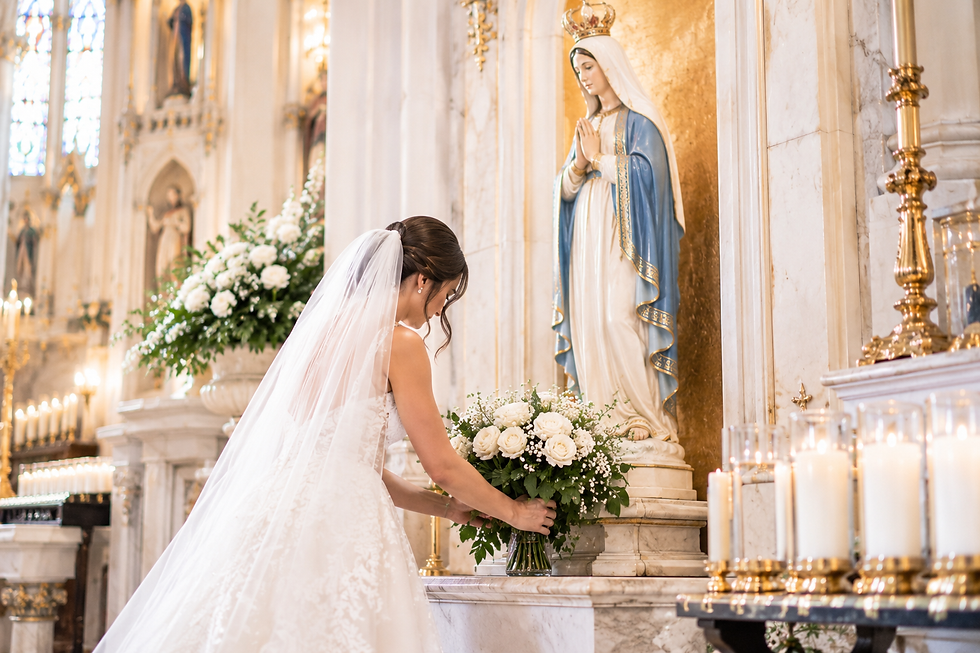
Here's the loveliest home for it. Many Catholic couples include a Marian devotion in their wedding: at a certain point — often after Communion — the bride and groom step aside to an image or statue of the Blessed Virgin Mary, offer flowers, and spend a moment in quiet prayer, asking her intercession as they begin married life. A Marian hymn or an Ave Maria often accompanies this. That's frequently a more fitting place for it than the bride's processional, because it gives the music a moment of genuine prayer to belong to rather than serving as entrance background.
The best-known settings to ask about:
Ave Maria — Franz Schubert (originally "Ellens dritter Gesang"; the familiar Latin Ave Maria text is a later fitting). Warm, soaring, deeply beloved.
Ave Maria — Bach/Gounod (Gounod's melody laid over Bach's Prelude in C). Flowing and tender.
Both are treasured; which suits your wedding depends on your musicians and your parish's practice.
Two gentle clarifications so nothing gets overstated. A Marian devotion is not required — it's a beautiful option, not an obligation, and plenty of faithful Catholic weddings don't include one. And an Ave Maria doesn't automatically belong at every Catholic wedding just because it's famous; it belongs where it can be truly prayerful.
But if Our Lady has been part of your faith, there's something quietly moving about turning to her at the very start of your marriage — asking the woman who said yes to God, and who was there at Cana when the wine ran out, to walk with you. Many couples find it one of the most tender moments of the whole day. If that stirs something in you, bring it to your music director and ask where it would best fit in your liturgy.
Recessional Music — Now You Can Go Joyful
This is the moment the whole day has been building toward. The vows are spoken. The rings are on. You are, right now, married — and you're walking back down that aisle together as husband and wife for the very first time.
So the recessional gets to be joyful, radiant, unrestrained. This is where the trumpets come out and the organ opens up. It's a wonderful place for:
festive organ music
trumpet fanfares
triumphant classical sacred repertoire
Beautiful possibilities to ask your parish about:
Trumpet Tune — Purcell (or Trumpet Tune in C). Bright, bouncing, celebratory — a classic recessional that practically makes you smile.
Hornpipe / Allegro from Water Music — Handel. Buoyant and festive, full of momentum. Pure joy.
Ode to Joy — Beethoven. Soaring and triumphant, and instantly beloved by everyone in the pews.
Toccata (from Symphony No. 5) — Charles-Marie Widor. The great cathedral showstopper — a cascading, thrilling organ toccata. If your parish has a big organ and an organist who loves it, this is a jaw-dropping way to exit.
La Réjouissance (from Music for the Royal Fireworks) — Handel. Regal and jubilant, exactly as celebratory as it sounds.
In Thee Is Gladness — J.S. Bach. Dancing and joyful, with the word "gladness" right in the title — a lovely, slightly less common choice.
A quick honest note in the same spirit as the "Here Comes the Bride" section: Mendelssohn's famous Wedding March (the recessional one, from A Midsummer Night's Dream) is another culturally beloved piece with theatrical, secular roots. Some parishes welcome it; others set it aside for the same reasons as the Bridal Chorus. As always — ask. And if it's set aside, any of the joyful sacred options above will send you out the doors on a wave of sound.
Catholic Wedding Music Ideas by Style
Sometimes you know exactly how you want your wedding to feel — you just don't yet know the names of the pieces that create that feeling. This roundup is for you. Think of these as starting points to bring to your music director, not fixed playlists.
Traditional & Timeless
Processional: Canon in D (Pachelbel) · Jesu, Joy of Man's Desiring (Bach)
Communion: Panis Angelicus (Franck) · Ave Verum Corpus (Mozart)
Marian: Ave Maria (Schubert)
Recessional: Trumpet Tune (Purcell) · Ode to Joy (Beethoven)
Grand Cathedral Wedding
Processional: Prince of Denmark's March / Trumpet Voluntary (Clarke) · Rondeau (Mouret)
Communion: Panis Angelicus (Franck) with choir
Marian: Ave Maria (Bach/Gounod)
Recessional: Widor Toccata · La Réjouissance (Handel)
Soft, Romantic & Reverent
Processional: Air on the G String (Bach) · Arioso (Bach)
Communion: O Sacrum Convivium · Ave Verum Corpus (Mozart)
Marian: Ave Maria (Schubert)
Recessional: In Thee Is Gladness (Bach) · a gentle festive trumpet tune
Marian Catholic Wedding
Processional: Jesu, Joy of Man's Desiring (Bach)
Communion: Panis Angelicus (Franck)
Marian devotion: Ave Maria (Schubert or Bach/Gounod), sung as you bring flowers to Our Lady
Recessional: Ode to Joy (Beethoven)
Traditional Parish Wedding
Processional: Canon in D (Pachelbel)
Communion: a hymn your parish already sings well, like Gift of Finest Wheat
Marian: Ave Maria (Schubert), if desired
Recessional: Trumpet Tune (Purcell)
The goal of these groupings isn't to hand you a rigid script. It's to help you walk into your music meeting able to say, "We're picturing something grand and cathedral-like," or "We want it soft and prayerful" — and to have a few real names ready when your music director asks.
Sample Catholic Wedding Music Plans
Here are four complete sample plans to spark ideas. Read them as inspiration, not approved playlists — every parish is different, and your music director should review your actual selections.
Please note: These are examples to inspire your planning, not universal approved lists. Always review your final selections with your parish music director.
Sample 1 — Classic & Timeless Catholic Wedding (with Mass)
Prelude: Musician's choice — Bach Air on the G String, Handel Air
Wedding Party: Canon in D — Pachelbel
Bride: Jesu, Joy of Man's Desiring — Bach
Responsorial Psalm: Psalm 128 setting (from your cantor)
Offertory: O Perfect Love
Mass Setting: Your parish's usual setting
Communion: Panis Angelicus — Franck
Marian Devotion: Ave Maria — Schubert
Recessional: Trumpet Tune — Purcell
Sample 2 — Grand Traditional Church Wedding (with Mass)
Prelude: Festive organ and trumpet repertoire (musician's choice)
Wedding Party: Trumpet Voluntary / Prince of Denmark's March — Clarke
Bride: Rondeau — Mouret
Responsorial Psalm: Psalm 145 setting (from your cantor)
Offertory: Ave Verum Corpus — Mozart (choir)
Mass Setting: Your parish's usual setting
Communion: Panis Angelicus — Franck (choir)
Marian Devotion: Ave Maria — Bach/Gounod
Recessional: Toccata (Symphony No. 5) — Widor
Sample 3 — Soft & Prayerful Catholic Wedding (with Mass)
Prelude: Gentle strings and organ (musician's choice)
Wedding Party: Air on the G String — Bach
Bride: Arioso — Bach
Responsorial Psalm: Psalm 34 setting (from your cantor)
Offertory: O Sacrum Convivium
Mass Setting: Your parish's usual setting
Communion: Ave Verum Corpus — Mozart
Marian Devotion: Ave Maria — Schubert
Recessional: In Thee Is Gladness — Bach
Sample 4 — Marian-Inspired Catholic Wedding (with Mass)
Prelude: Sacred repertoire, including a quiet Marian hymn (musician's choice)
Wedding Party: Canon in D — Pachelbel
Bride: Jesu, Joy of Man's Desiring — Bach
Responsorial Psalm: Psalm 103 setting (from your cantor)
Offertory: Panis Angelicus — Franck
Mass Setting: Your parish's usual setting
Communion: Gift of Finest Wheat
Marian Devotion: Ave Maria (Schubert or Bach/Gounod), with flowers offered to Our Lady
Recessional: Ode to Joy — Beethoven
For a sense of when in your planning to actually book the music meeting and lock these choices in, our post on Catholic wedding planning timeline lays out a helpful sequence.
What If We Have a String Quartet, Violinist, or Harpist?
A string quartet gliding through your processional, a solo violin during Communion, a harp shimmering under the prelude — these can be genuinely gorgeous. Just one crucial thing to know: hiring your own musicians does not bypass your parish's music requirements. Ask the parish first, before you sign anything.
Parishes differ widely here. Some:
require their own organist and/or cantor for the liturgy
welcome outside musicians with approval
have restrictions on certain instruments
require any outside musicians to coordinate with the parish music director
expect the outside musicians to work from the parish's approved music
None of that means you can't have your dream harpist. It means you confirm the arrangement with the parish before committing. Which leads to the most practical sentence in this section:
Confirm your parish's policy before you sign a contract or pay a nonrefundable deposit to any outside musician. It can be a difficult, expensive thing to undo a booking that turns out not to fit your parish's rules — and completely avoidable with one phone call up front.
What About Recorded Music?
It's a fair question in a Spotify-and-Bluetooth world: can't we just play the track we love through the church speakers?
A Catholic wedding is a liturgy, and the liturgy is meant to be carried by living voices and instruments in the room. Many parishes expect live liturgical music and make no provision for pre-recorded tracks during the ceremony. Some are more flexible in specific circumstances, but you shouldn't assume it.
So before you build any part of your plan around a recording, ask your parish what their policy is. If live music feels daunting, know that most parishes have an organist and cantor precisely so you don't have to arrange all of it yourself — that's part of what your music meeting is for.
Does the Liturgical Season Affect Our Wedding Music?
Yes — gently, but really. The Church's liturgical calendar keeps turning on your wedding day too, and a couple of seasons carry particular musical character worth knowing about.
Lent is the big one. During Lent, the Church asks for musical restraint: instruments are used to support the singing rather than for grand solo display, and the joyful Alleluia is set aside in favor of a different Gospel acclamation. (There are exceptions on certain days, like the Fourth Sunday of Lent, solemnities, and feasts.) So a Lenten wedding tends to be quieter and more restrained by design — which can be its own kind of beautiful, but it's good to expect it rather than be surprised.
Advent calls for a moderation of its own — a certain restraint that doesn't leap ahead to full Christmas joy before Christmas arrives.
The Easter season, by contrast, is radiant and celebratory — a wonderful time for glorious music.
None of this is a reason to worry, and it's not a set of rules to memorize. It's simply a reason, if your wedding falls in Advent or Lent, to talk with your parish early so your music fits the season gracefully. Your music director will know exactly how to make a Lenten or Advent wedding beautiful within the season's character — and the beauty of a quieter, more prayerful wedding shouldn't be underestimated.
Questions to Ask Your Catholic Wedding Music Director
Here's a checklist to bring — or send ahead — to your music meeting. Answers to these will resolve about ninety percent of the confusion in this whole guide:
Do you have an approved or recommended wedding music list?
Do we choose our own processional music?
May the bride have a separate processional piece?
Which Mass setting will we use for our wedding?
Do we select the Responsorial Psalm, and do you provide the setting?
Which Communion hymns do you recommend?
Is a Marian devotion permitted or customary here?
Where would an Ave Maria best fit in our liturgy?
Which recessional pieces work especially well on your organ?
Are outside musicians allowed?
Is a cantor required, and is one included?
Can we bring a string quartet, violinist, or harpist — and what's the process?
Are recorded tracks allowed at any point?
Are there any pieces you specifically do not permit?
Does our wedding date or liturgical season affect our music choices?
When are our final music selections due?
Will our musicians attend the rehearsal?
Do we need any music licensing or permissions for what we print in our program?
Copy this, send it to your fiancé, and bring it to the meeting. Hopefully you can get the music sorted out that day, and feel much lighter with one major thing off the list.
Common Catholic Wedding Music Mix-Ups — Things That Are Easier to Sort Out Early
Choosing music before asking the parish. Falling in love with a processional first, then learning it doesn't fit, is the most common heartache — and the most avoidable. Get the guidelines first.
Hiring musicians before confirming parish policies. Confirm what's allowed before any contract or deposit.
Forgetting about congregational music. A wedding isn't a performance for the couple; the assembly prays and sings too. Music your guests can join lifts the whole liturgy.
Treating Communion as another romantic couple moment. It's centered on Christ in the Eucharist — let that shape the music.
Trying to choose every single musical detail yourself. Remember, the music director handles the Psalm, the Alleluia, and the Mass parts. You don't have to fill every blank.
Forgetting that Advent or Lent may shape the music. If your date falls in either, talk to your parish early.
Printing song lyrics in your program without checking permissions. Copyrighted music and texts often require licensing — more on that next.
Every one of these is easy to get right when you know about it up front. That's really all this list is for.
What Should We Put in Our Catholic Wedding Program About the Music?
A well-made wedding program helps your guests follow along and pray with you — and the music is a big part of that. A Nuptial Mass program might list:
the processional title
any hymn titles
the Responsorial Psalm
the Mass setting
the Communion hymn
a Marian hymn, if you have one
the recessional
If your congregation is expected to sing — say, on a hymn or the Mass parts — your parish or music director can advise what should be printed so people can join in, and what copyright or licensing acknowledgments need to appear.
One genuinely important caution here: don't copy full copyrighted song lyrics into a Canva template without checking the permissions. Much sacred and contemporary music is under copyright, and reprinting lyrics or music often requires a license (many parishes hold one, such as a reprint license, that may cover it — ask). It's a small step that keeps everything above board.
If building the program itself feels like one more thing on an already-long list, this is the one place a tool can genuinely help. Catholic Vows Co. offers editable Catholic wedding Mass programs designed around the actual flow of the Nuptial Mass, so your readings, music, responses, and guest guidance all sit in one organized place.
Catholic Wedding Music FAQ
What do Catholic brides traditionally walk down the aisle to? There's no single universal piece. Common, much-loved choices include Pachelbel's Canon in D, Bach's Jesu, Joy of Man's Desiring, and Clarke's Trumpet Voluntary (Prince of Denmark's March) — all lovely options to ask your parish about.
Can I choose my own processional music? Often yes, within your parish's guidelines and with the music director's approval. Some parishes give more latitude than others, so ask early.
Does the bride get a separate song? Sometimes. Some parishes give the bride her own entrance piece; others use one processional or an entrance hymn for everyone. Ask what your parish does.
Can Catholics use "Here Comes the Bride"? Many Catholic parishes don't permit or recommend it, because it's the theatrical Bridal Chorus from Wagner's Lohengrin rather than sacred music — but policies vary, and some parishes allow it. Ask your music director, and know there are beautiful alternatives.
Can I use Canon in D at a Catholic wedding? It's one of the most common and beloved processionals at Catholic weddings — a great option to confirm with your parish.
Can I walk down the aisle to Ave Maria? You can ask, but an Ave Maria is often better suited to a Marian devotion later in the liturgy than to the processional. Talk it through with your music director.
Can I use a secular song if it's instrumental? Making a secular song instrumental doesn't automatically make it liturgical music, and most parishes reserve popular love songs for the reception. Ask your parish — and consider giving that song a starring role at your first dance instead.
Can we use "A Thousand Years"? It's a much-loved song, but as a contemporary pop piece it's typically reserved for the reception rather than the wedding liturgy. Your parish has the final word — the first dance is often its perfect home.
Can we use "Can't Help Falling in Love"? Same gentle answer: beautiful song, usually better placed at the reception or first dance than in the liturgy. Ask your parish, but don't feel you have to give it up — just relocate it.
Do Catholic weddings have an Offertory song? At a Nuptial Mass, there may be music during the Preparation of the Gifts — a sacred hymn, an instrumental, a choir piece, or even prayerful silence. Not every quiet moment needs to be filled. Ask your parish what fits.
What music is needed for a Catholic wedding without Mass? Typically a prelude, the processional and bride's entrance, the Responsorial Psalm, the Gospel Acclamation, an optional Marian devotion, and the recessional. The Offertory and Eucharistic Mass parts fall away when there's no Liturgy of the Eucharist.
Do we need a cantor? Many parishes require or strongly prefer one to lead the sung parts of the liturgy. Ask whether a cantor is required and whether one is included.
Can we hire a violinist? Often yes, with parish approval and coordination with the music director. Confirm the parish's policy before signing any contract.
Can we use recorded music? Usually not — many parishes expect live liturgical music and make no provision for recordings during the ceremony. Ask before planning around a track.
What songs are sung during Communion? Sacred, Eucharistic music that reflects the reception of Christ — pieces like Panis Angelicus (Franck), Ave Verum Corpus (Mozart), or hymns such as Gift of Finest Wheat.
Is Ave Maria required? No. A Marian devotion and an Ave Maria are beautiful options, not obligations. Plenty of faithful Catholic weddings don't include one.
When does Ave Maria happen? When included, it commonly accompanies a Marian devotion — often after Communion, as the couple offers flowers to an image of Our Lady. Placement varies by parish, so ask.
Who approves Catholic wedding music? Your parish has the final say, usually through the pastor and the parish music director. They're your partners in this — start the conversation early.
A Last Word — the Music Becomes Part of the Memory
Years from now, you may hear the opening notes of your processional and be right back there — standing at the doors, heart pounding, everyone turning to look, the church full of the people who love you. You may hear your Communion hymn and remember kneeling beside your new husband or wife. The music becomes woven into the memory of the day in a way that lasts a lifetime.
But its purpose during the wedding is greater still. It isn't there to create a romantic atmosphere, though it will. It's there to help the whole Church pray while the two of you begin married life before God — to lift a room full of hearts toward Heaven in the very moment you make your promises.
So here's the gentle encouragement to end on: you don't need to assemble the most unique or impressive Catholic wedding playlist anyone's ever heard. You just need music that is beautiful, prayerful, suited to the liturgy, meaningful to you, and blessed by your parish. Choose from within those gentle boundaries, trust your music director, and then let the liturgy itself be as beautiful as it already is.
It's going to be lovely. Truly. Now go have that conversation with your music director — and enjoy this part. It's one of the most beautiful pieces of planning a Catholic wedding, once you know how it works.

Comments