Catholic Wedding Ceremony vs. Nuptial Mass Explained
Updated: Aug 26

If you've recently started marriage preparation, you may have hit a question you weren't expecting: will you celebrate your marriage within Mass, or outside of Mass?
For a lot of couples, that's the first moment they realize a Catholic wedding isn't just one fixed thing. There are actually two legitimate ways the Church celebrates the Sacrament of Matrimony, and they're structured a little differently. If no one has explained the difference to you yet, that's completely normal, and you're in exactly the right place.
Here's what we'll walk through together: what actually happens in each one, where Communion fits in, roughly how long each tends to run, when each form is commonly used, what changes when one of you isn't Catholic, and how couples usually make this decision with their priest. None of it is complicated once you can see it laid out.
First, What Is a Nuptial Mass?
A Nuptial Mass is a Catholic wedding celebrated within the Mass. In other words, your marriage rite takes place inside the larger structure of a full Mass, the same Mass Catholics celebrate on Sundays, with your wedding woven into it.
In broad strokes, it usually unfolds like this:
The Introductory Rites, where the priest welcomes everyone and the celebration begins
The Liturgy of the Word, with Scripture readings, a psalm, the Gospel, and a homily
The Celebration of Matrimony, where you exchange your consent, or vows, and your rings are blessed and given
The Liturgy of the Eucharist, which includes the Nuptial Blessing over the couple and Holy Communion
The Concluding Rites, with a final blessing and the dismissal
We won't unpack every prayer here, since the order of a Nuptial Mass really deserves its own walkthrough. The key thing to notice is that a Nuptial Mass includes the full Eucharistic celebration, with Communion, right there inside your wedding.
For two Catholics, that's often deeply meaningful. It places your marriage within the Eucharist, the center of Catholic worship, so that the beginning of your married life is joined to the sacrament the Church holds most dear. Many couples describe it as starting their marriage at the altar in the fullest sense.
What Is a Catholic Wedding Ceremony Without Mass?
The Sacrament of Matrimony can also be celebrated using the Catholic marriage rite on its own, without the full celebration of Mass. This is sometimes called celebrating marriage "outside of Mass," and it's a complete, valid, and beautiful Catholic wedding.
Its structure looks familiar in many ways:
The Introductory Rites and a greeting
Scripture readings and a homily
The Celebration of Matrimony, where you exchange your consent and rings
The Nuptial Blessing and prayers over the couple
The Concluding Rites and final blessing
The main structural difference is that there is no Liturgy of the Eucharist and no distribution of Holy Communion as part of the ceremony.
It's worth pausing on one important point here. When celebrated according to the Church's requirements, a wedding outside of Mass is not a "backup" version of Catholic marriage. For two baptized Christians, the Sacrament of Matrimony is truly celebrated through the exchange of consent.
At the same time, this doesn't mean that celebrating Matrimony within Mass and celebrating it outside of Mass are spiritually identical. The Eucharist holds a unique and central place in Catholic life: Catholics believe that Jesus Christ is truly present—Body, Blood, Soul, and Divinity—in the Blessed Sacrament. When Matrimony is celebrated within Mass, the couple's vows are therefore placed within the Church's celebration of Christ's Eucharistic sacrifice and, when properly disposed, the Catholic bride and groom may receive Him in Holy Communion as they begin their married vocation.
So while a Catholic wedding outside of Mass can be a true and sacramental celebration of Matrimony, the presence of the Eucharist at a Nuptial Mass should never be treated as simply an optional wedding detail. It is something altogether more profound.
What's the Main Difference?
If you remember one thing, let it be this: the biggest difference between the two is the Liturgy of the Eucharist.
A Nuptial Mass includes the Eucharistic part of the Mass and Holy Communion. A Catholic wedding celebrated outside of Mass does not. Almost everything else, the readings, the vows, the rings, the blessing over the couple, is shared by both.
Here's a simple side-by-side:
Wedding Within Mass | Wedding Without Mass | |
Scripture readings | Yes | Yes |
Exchange of consent/vows | Yes | Yes |
Blessing of rings | Yes | Yes |
Nuptial Blessing | Yes | Yes |
Liturgy of the Eucharist | Yes | No |
Holy Communion | Yes | No |
Typical length | Longer | Shorter |
The "typical length" row is a general tendency, not a stopwatch. Actual timing depends on your parish, your music, and how your particular celebration is put together.
How Long Is a Catholic Wedding?
This is one of the most common questions couples ask, usually because they're trying to plan the rest of the day around it.
As a general rule, a wedding celebrated within Mass tends to run longer, since it includes the full Eucharistic celebration, while a ceremony outside of Mass is usually shorter. Beyond that, timing shifts with your music, the number of readings, any customs you include, and how your parish typically celebrates.
We'd gently steer you away from planning around an exact number you found online. The most reliable thing you can do is ask your parish or wedding coordinator what's realistic for the way your wedding is being celebrated. They know their church, and their answer is the one worth building your timeline around.
What If One of Us Isn't Catholic?
This is where the two forms often come into focus, so if this is your situation, this section is especially important.
When a Catholic marries a baptized Christian who isn't Catholic, the wedding is often celebrated outside of Mass. In some circumstances, however, Matrimony may be celebrated within Mass, and your priest will help you understand what is appropriate for your particular situation.
One important reason for this conversation is the Eucharist. Catholics believe that the Eucharist is truly the Body and Blood of Jesus Christ—not simply a symbol or a wedding tradition. Because receiving Holy Communion also expresses unity with the Catholic faith, a non-Catholic spouse and many non-Catholic guests ordinarily would not receive Communion at a Nuptial Mass.
That can understandably raise questions for an engaged couple. But it doesn't mean the Eucharist should be thought of as something to include or leave out simply according to preference. The Church's different forms of celebrating Matrimony reflect both reverence for the Eucharist and pastoral care for couples whose circumstances differ.
When a Catholic marries someone who has not been baptized, the marriage is ordinarily celebrated outside of Mass. Your priest will guide you through the permissions or dispensations that may be needed and explain what the celebration will look like.
And if a non-Catholic fiancé is genuinely interested in becoming Catholic, that is something beautiful to explore—not simply for the sake of having a Nuptial Mass, but because he or she is sincerely being drawn toward the Catholic faith. The parish can help that person learn more about Catholicism and, when appropriate, begin the process of becoming Catholic through OCIA.
Whatever your circumstances, talk openly with your priest. A Catholic wedding can be a beautiful invitation to understand more deeply not only the Sacrament of Matrimony, but the faith that gives the Sacrament its meaning.
Does Celebrating Matrimony Within Mass Make a Difference?
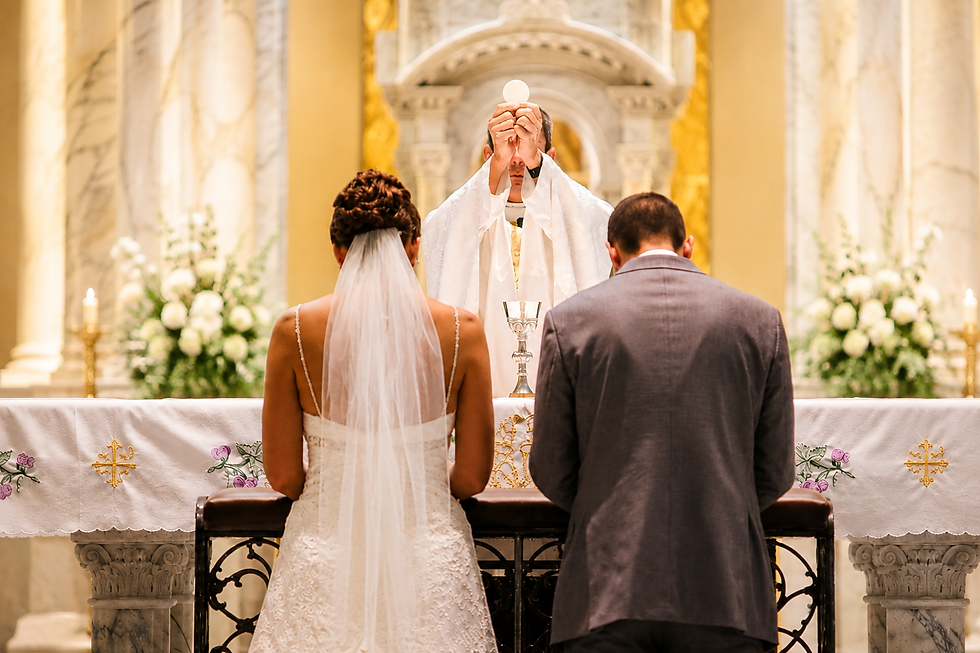
Absolutely—but perhaps not in the way you might think.
A Catholic wedding celebrated outside of Mass can be a valid and beautiful celebration of Matrimony, and when two baptized Christians validly marry, their marriage is sacramental. The validity of their marriage does not depend upon celebrating a Nuptial Mass.
But that doesn't mean the two forms are spiritually identical.
For Catholics, the Eucharist is the source and summit of the Christian life. We believe that Jesus Christ is truly present—Body, Blood, Soul, and Divinity—in the Blessed Sacrament. When Matrimony is celebrated within Mass, the couple exchanges their vows within the celebration of Christ's Eucharistic sacrifice. When both bride and groom are Catholic and properly disposed to receive Holy Communion, they can then receive Christ in the Eucharist together as they begin their married vocation.
That is not simply an extra tradition added to the wedding ceremony. It is a profound gift.
At the same time, there are circumstances in which the Church provides for Matrimony to be celebrated outside of Mass, particularly in some marriages between a Catholic and a non-Catholic. If your priest recommends this form for your wedding, you don't need to view your marriage as a "lesser" one. Rather, allow him to help you understand both the sacredness of Matrimony and the reasons the Church recommends a particular form for your circumstances.
The important thing is to resist treating the decision as merely a matter of preference—Mass or no Mass, longer or shorter, whichever feels right. The Eucharist is far more than a wedding-day option. It is Jesus Christ truly present, and it deserves the reverence and love at the heart of Catholic faith.
Can We Choose Which One We Want?
Yes and no—and this surprises some couples, so it's good to understand early.
Whether your marriage will be celebrated within Mass or outside of Mass isn't simply a wedding-day preference or a choice from a menu. It's a conversation you'll have with your priest during marriage preparation, with the Church's guidance and your particular circumstances in mind.
Several things can shape that decision:
Whether both of you are Catholic
Whether one of you is a baptized non-Catholic Christian or is not baptized
Your particular sacramental situation
The permissions or dispensations that may be required
Pastoral considerations specific to your circumstances
The liturgical norms and guidance of the Church
Because of all that, bring the question to your parish early in the planning process. Understanding how your marriage will be celebrated will shape many of the practical decisions that follow—from readings and music to your wedding-day timeline and Mass program.
More importantly, marriage preparation is an opportunity to understand why the Church celebrates Matrimony as she does. Don't be afraid to ask your priest questions about the Mass, the Eucharist, or the Sacrament of Matrimony itself. These aren't simply details to settle for the wedding day; they're part of understanding the Catholic marriage you're preparing to enter.
What About Our Non-Catholic Guests?
Whichever form your wedding takes, it's worth remembering that a Catholic wedding may feel unfamiliar to guests who've never attended one—and that's completely okay.
A Nuptial Mass in particular has a rhythm that may be new to some of your guests. There's standing, sitting, and kneeling, spoken and sung responses, the Sign of Peace, and, most importantly, the celebration of the Eucharist. Rather than minimizing these distinctly Catholic parts of your wedding, a little gentle explanation can help guests understand what they're witnessing and why it matters.
A clear wedding program can go a long way. Simple cues for when to sit, stand, or kneel, brief explanations of unfamiliar parts of the Mass, and a warm note about Holy Communion can help non-Catholic guests participate respectfully and feel welcomed without suggesting that every part of the liturgy is open to everyone in the same way.
This is especially important when it comes to the Eucharist. Catholics believe that Holy Communion is truly the Body and Blood of Jesus Christ and that receiving the Eucharist also expresses communion with the Catholic Church. A brief, gracious note explaining who may receive Communion isn't meant to make anyone feel excluded. It's a way of honoring what Catholics believe while helping guests know what to expect.
Your Catholic wedding doesn't need to hide or soften its Catholic identity to be welcoming. With a little thoughtful guidance, it can instead offer your family and friends a beautiful glimpse into the faith at the heart of the marriage you're beginning.
Questions to Ask Your Priest
If you want to walk into your next meeting feeling prepared, here's a short list you can bring with you:
Will our marriage be celebrated within Mass or outside of Mass?
What factors determine which form we'll use?
How many readings do we choose, and can we select our own Scripture readings?
Will Communion be celebrated?
Are there parish guidelines for music?
Are there specific instructions we should include in our wedding program?
About how long should we expect the ceremony to last?
Are there customs or traditions specific to our parish or diocese?
Your priest or deacon will be glad you asked. These are exactly the questions that help your wedding come together smoothly.
So, Which One Should We Have?
By now you can probably feel where this lands: the best starting point isn't a pros-and-cons list. It's a conversation with your priest.
For two practicing Catholics, celebrating Matrimony within Mass beautifully places the beginning of married life within the celebration of the Eucharist—the source and summit of the Christian life. The couple exchanges their vows before God and then, when properly disposed, receives together the Body and Blood of Christ, asking for His grace as they begin their vocation as husband and wife.
When one spouse isn't Catholic, the Church may recommend celebrating Matrimony outside of Mass, depending on the couple's particular circumstances. This isn't because the Eucharist matters less. In fact, the Church's careful guidance reflects precisely how seriously Catholics understand both Matrimony and the Eucharist.
So rather than asking simply, "Which kind of Catholic wedding do we want?" bring the question to your priest. Let him help you understand what the Church calls for in your circumstances—and, just as importantly, why.
Whatever your situation, allow your wedding preparation to draw you more deeply into the meaning of Catholic marriage. And if you're able to celebrate your marriage within Mass, don't overlook what an extraordinary gift that is: beginning your married vocation at the altar and receiving Jesus Christ in the Eucharist together.
A Little Understanding Makes Everything Easier
Once you understand the difference between these two forms, so much of the rest of your planning gets clearer. Your readings, your music, your ceremony timeline, your program, and the way you communicate with guests all flow from knowing which celebration you're preparing for.
At Catholic Vows Co., we love helping couples make the ceremony feel just as thoughtfully planned as every other part of the day. Once you know which form of the wedding liturgy you'll be celebrating, a clear, beautiful program can become a helpful guide for guests as well as a keepsake you'll want to hold onto long after the day is over.
Wherever your conversation with your priest leads, you're doing a beautiful thing: preparing to receive a sacrament with care and intention. That's a wonderful way to begin.


Comments