Catholic Wedding Readings: How to Choose the Readings for Your Wedding Mass
You've picked the church. You may have a date, maybe even a dress. And then your parish hands you a booklet — or sends you a link to a planning portal — and somewhere in all of it is a page of Scripture options with a quiet instruction attached: choose your readings.
If your first thought was "Wait, we have to choose these too? And how are we supposed to know which ones go together?" — you are in very good company. Almost every couple has that moment. There's a lot to plan for a wedding, and the readings can feel like one more decision landing on an already-full list, especially when the choices come with unfamiliar names and verse numbers.
Here's the reassuring part. Once you understand what each reading is actually doing within the liturgy — where it falls, who proclaims it, and what it's meant to say — choosing becomes not just manageable but genuinely meaningful. These aren't decorative quotations picked because they sound romantic. They are Sacred Scripture, proclaimed aloud in church as you prepare to enter the covenant of marriage. Years from now, long after the flowers are gone, these are words you may find yourself returning to.
So let's walk through it together, gently and in order.
First, What Readings Do You Actually Choose for a Catholic Wedding?
Before we talk about individual passages, it helps to see the whole map. When your wedding is celebrated within Mass — a Nuptial Mass — the Scripture portion, called the Liturgy of the Word, ordinarily unfolds in this order:
First Reading → Responsorial Psalm → Second Reading → Gospel Acclamation → Gospel
Here's what each one is.
First Reading. This normally comes from the Old Testament, and it's usually the reading you'll choose first. It sets a kind of foundation — often God's design for marriage, the covenant, or the joining of husband and wife. (There's one small exception: during the Easter season, the Church provides for this first reading to be drawn from the New Testament instead. If your wedding falls in that season, your parish will point you to the right options — it's nothing you need to untangle on your own.)
Responsorial Psalm. This follows the First Reading, and it's a little different from the others. Rather than being read straight through, it's a psalm in which the whole congregation takes part, singing or saying a short repeated response between verses. It's ordinarily sung by a cantor or psalmist, so in many parishes the music ministry helps guide this choice rather than leaving it entirely to you.
Second Reading. This one comes from the New Testament — the letters of the apostles and the Book of Revelation. Some of the richest passages about Christian love, sacrifice, and life in Christ live here. This is often where couples find the words that feel most like theirs.
Gospel Acclamation. Just before the Gospel, the congregation stands and sings the acclamation — the "Alleluia" (replaced with a different acclamation during Lent). In most parishes this is simply part of how the Mass flows, and the music ministry handles it, so it usually isn't a separate decision you need to agonize over.
Gospel. This is the high point of the Liturgy of the Word — the moment everyone stands to hear the words of Christ himself. For that reason, the Gospel is always proclaimed by the deacon or the priest, never by a family member or friend. Choosing your Gospel reading is choosing which words of Jesus will be spoken over the beginning of your marriage.
One important note before you dive in: your parish may give you a wedding-liturgy planning booklet or a specific list of approved choices. That's your true starting point. The Church provides a set of approved Scripture selections for the celebration of Matrimony, and couples ordinarily choose from those options rather than picking any favorite Bible verse. Start with what your parish gives you — everything below is meant to help you understand and pray through those choices, not replace them.
How to Choose Your Catholic Wedding Readings
This is really the heart of it. Rather than scanning for whichever passage sounds prettiest, try moving through it as a small, unhurried process. Here's one that works beautifully.
Step 1: Read the choices together. It's tempting to split the list — you take the Old Testament, he takes the Gospel — and reconvene later. This is where its great to sit down together instead, and give the readings your real attention for an hour. These words are about the two of you becoming one, and there's something fitting about choosing them as one.
Step 2: Notice which themes speak to the marriage you hope to build. As you read, pay attention to what stirs something in you. Different readings carry different notes: covenant and faithfulness; the two becoming one; sacrificial love; serving one another; keeping Christ at the center; God's presence in the ordinary days of married life; building a life of faith together; family and fruitfulness; perseverance through hard seasons; charity. And one that's easy to miss but quietly beautiful — the idea that a husband and wife are meant to help one another toward Heaven. You don't need every theme. You're listening for the two or three that sound like the marriage you actually hope to build.
Step 3: Look beyond the "prettiest" verse. A reading can be beautiful not because its language is lovely but because of what it asks of a married couple. Some of the most powerful passages aren't romantic at all, but practical. Read for meaning and context, not for length.
Step 4: Think about the readings as a set. This is the step most couples skip, and it's the one that makes a real difference. A lovely combination might let the First Reading establish God's design and the covenant of marriage, the Second Reading illuminate what Christian love actually looks like, and the Gospel turn you both toward Christ and the life of discipleship you're beginning together. Chosen this way, the readings become a small journey rather than three variations on one note.
Step 5: Pray with your finalists. Once you've narrowed things down, read your final choices aloud to each other, and spend a little time praying over them. Ask God, simply, whether these are the words he wants spoken over your marriage. You may be surprised how quickly one combination starts to feel like home.
Step 6: Confirm everything with your priest or parish. Before you print a single program or consider it settled, make sure your selections are approved and confirmed according to your parish's process. Wedding dates, liturgical seasons, and certain feast days can all affect what may be used, and your priest or wedding coordinator is the one who knows how those pieces fit for your particular day.
Popular Catholic Wedding Readings — And What They Mean
Here are several of the most beloved options, with a short sense of each one's heart. (We're giving you the citation and the theme rather than the full text — the words are best encountered in the approved liturgical version your parish provides, or in your Bible.)
Genesis 1:26–28, 31a — God creates humanity, male and female, in his own image, blesses them, and calls their union good. Couples are often drawn to it because it places their marriage inside God's very first intention for creation, and because it speaks so naturally of welcoming children.
Genesis 2:18–24 — "It is not good for the man to be alone." God fashions a companion, and the two become one flesh. This is the tender, foundational picture of marriage as companionship and union — the reading many couples feel they've been waiting to hear.
Tobit 8:4b–8 — On their wedding night, Tobiah and Sarah rise and pray together before anything else, asking God's mercy and blessing on their life together. It's a quietly astonishing image: a marriage that begins on its knees. If you hope your home will be a praying home, few readings say it more beautifully.
Song of Songs 2:8–10, 14, 16a; 8:6–7a — The beloved calls to his love, and love is declared "strong as death," a flame that "many waters cannot quench." It's ardent and unashamed — a reminder that spousal love, in all its intensity, is God's own gift and worthy of a place in his liturgy.
1 Corinthians 12:31–13:8a — "Love is patient, love is kind…" Yes, this is the one you've heard at countless weddings. St. Paul isn't describing a feeling; he's describing a discipline. This love is patient when patience is hard, kind on the difficult days, not jealous or self-seeking, willing to bear and endure. Read slowly, it's less a sentiment than a rule of life for two people — and that's exactly why it endures.
Ephesians 5:2a, 21–33 (a shorter form, 5:2a, 25–32, is also offered) — This reading is sometimes reduced to a single line about wives and husbands, and that does it a real disservice. Its true center is Christ. Paul asks spouses to "be subordinate to one another out of reverence for Christ," and then holds up the highest possible standard for husbands: love your wife "as Christ loved the Church and handed himself over for her." The model here isn't power; it's self-gift — a husband called to lay down his life the way Christ did. Understood in that light, it's one of the most demanding and beautiful visions of marriage in all of Scripture. If it speaks to you, choose it with confidence.
Colossians 3:12–17 — "Put on, as God's chosen ones, heartfelt compassion, kindness, humility, gentleness, and patience… and over all these put on love." It reads almost like a wardrobe for married life: the virtues you clothe yourselves in each morning, with forgiveness woven right through the middle. Gentle, practical, and deeply hopeful.
Matthew 5:1–12a (The Beatitudes) — "Blessed are the poor in spirit… blessed are the peacemakers." Jesus sketches the shape of a whole Christian life. Chosen as a wedding Gospel, it quietly says that this marriage intends to be a place where the Beatitudes are lived.
Matthew 7:21, 24–29 — The wise builder puts his house on rock, and when the storms come, it stands. Marriages weather storms throughout your lifetime. This reading names the only foundation strong enough to hold — doing the will of God — and it's a favorite of couples who want to begin clear-eyed about that.
Matthew 19:3–6 — "What God has joined together, no human being must separate." Jesus points back to the beginning, to the two becoming one flesh, and speaks of marriage as permanent and as God's own work. A short, weighty, luminous choice.
John 2:1–11 (The Wedding Feast at Cana) — At a wedding, when the wine runs out, Jesus performs his first miracle — prompted by his mother's quiet attentiveness: "They have no wine… Do whatever he tells you." There is something wonderful about choosing the one Gospel scene where Christ himself is a wedding guest, and where Mary notices a need and brings it to her Son. It's a picture of exactly what you're inviting into your own marriage: the presence of Christ, and the intercession of his mother, at your table.
John 15:9–12 — "Remain in my love… love one another as I love you." Jesus ties the couple's love directly to his own, and makes his love the source and the measure of theirs. A tender, Christ-centered close to the Liturgy of the Word.
A quick word on making them fit together: the Church asks that at least one of the readings you choose speak explicitly of marriage. Most of the options above do, so this is easy to honor — but it's worth keeping in mind as you mix and match, and it's one more thing your priest will help you confirm.

Catholic Wedding Reading Combinations by Theme
Sometimes it's easier to start from a whole rather than a part. Here are five combinations to spark ideas. These aren't the "best" readings — there's no such ranking — just examples of how thoughtfully chosen passages can work together. Treat them as inspiration, and always confirm your final set with your parish.
For a Christ-Centered Marriage
First Reading: Genesis 2:18–24 · Second Reading: Colossians 3:12–17 · Gospel: John 15:9–12
This set moves gracefully from God's design for the two to become one, to the everyday virtues that clothe a Christian home, to Christ's own command to remain in his love. Together they say: our marriage begins in God's plan and stays rooted in Christ.
For a Marriage Centered on Sacrificial Love
First Reading: Song of Songs 2:8–10, 14, 16a; 8:6–7a · Second Reading: Ephesians 5:2a, 25–32 · Gospel: John 15:12–16
Here love strong as death meets Christ's self-gift for the Church meets his words, "No one has greater love than this, to lay down one's life." It's a combination for couples who understand that real love costs something — and want to say so.
For Couples Who Love Traditional Catholic Imagery
First Reading: Genesis 1:26–28, 31a · Second Reading: 1 Corinthians 12:31–13:8a · Gospel: Matthew 19:3–6
The most familiar and beloved of the choices, and familiar for good reason: creation and blessing, the great hymn to love, and Christ's own words on the permanence of what God joins. Timeless, and unmistakably Catholic.
For a Marriage Rooted in Prayer
First Reading: Tobit 8:4b–8 · Second Reading: Philippians 4:4–9 · Gospel: Matthew 7:21, 24–29
Tobiah and Sarah pray on their wedding night; Paul urges, "Have no anxiety at all, but… by prayer and petition… make your requests known to God"; and Jesus describes the house built on rock. A set for the couple who wants prayer to be the foundation, not an afterthought.
For Couples Drawn to the Wedding Feast at Cana
First Reading: Genesis 2:18–24 · Second Reading: 1 John 4:7–12 · Gospel: John 2:1–11
Built around Christ at Cana, without forcing every reading into the same key: the two become one flesh, "Beloved, let us love one another, because love is of God," and then Jesus turning water into wine at a wedding. Warm, joyful, and centered exactly where a marriage should be.
Who Reads What at a Catholic Wedding?
This part is refreshingly straightforward:
The First Reading is ordinarily proclaimed by a lector — a reader, often someone you invite.
The Responsorial Psalm, when sung, is ordinarily led by the psalmist or cantor rather than read by a lector.
The Second Reading is ordinarily proclaimed by a lector as well.
The Gospel is always proclaimed by the deacon or the priest.
What this means in practice is happy news: you can usually invite family members or friends to serve as lectors for the two readings before the Gospel — a beautiful way to include people you love in the liturgy itself. (Your parish's guidance always comes first here, so check how they handle it.)
If you're choosing readers, look for someone who's comfortable speaking clearly in a church, who will take the role seriously, who can attend the rehearsal if your parish asks, and who understands what they're actually doing — proclaiming the Word of God, not simply delivering a wedding-day speaking part. That last distinction matters, and the right person will feel the difference. Beyond that, don't overthink it.
Can a Non-Catholic Read at a Catholic Wedding?
This is one of the most common — and most tender — questions couples ask, especially when there's a beloved family member who isn't Catholic and whom you'd dearly love to include. It's a good and understandable question, and nothing to feel awkward about raising.
The honest answer is: it depends, and it isn't yours to decide alone. Church norms, along with diocesan and parish practices, govern who may serve as a lector, and those practices can vary. So rather than a blanket yes or no, the right move is simply to ask your priest or wedding coordinator directly and early. They'll tell you what's possible for your wedding, and often there are other meaningful ways to include someone even when the reading itself isn't the right fit.
Questions to Ask Your Priest or Parish Before Finalizing the Readings
A short conversation now prevents scrambling later. Here's a checklist you can bring:
Which marriage readings may we choose from?
Does our wedding date affect the readings we can select?
Are there special requirements during the Easter season, or on particular feast days or solemnities?
How many readings will our celebration include — two or three?
Do we choose the Responsorial Psalm, or does the music ministry help with that?
Who may serve as our lectors?
May a non-Catholic family member serve as a reader?
Do our readers need to attend the rehearsal?
When are our final selections due?
Will the parish provide the exact approved liturgical text we should use for our wedding program?
Asking these early — rather than the week of the wedding — is one of the simplest ways to keep your program accurate and your planning calm.
When Should We Choose Our Wedding Readings?
There's no single universal deadline, and your parish's timeline always takes priority — some ask for selections months ahead, others closer in. What's true everywhere is this: don't leave it until the final week.
Choosing a bit earlier gives you room for the things that make this meaningful rather than rushed — time to pray with the readings, to talk them through with your priest, to invite and prepare your lectors, to coordinate the Responsorial Psalm with your music ministry, and to get every citation exactly right on your program. It's one piece of the broader Catholic wedding planning process, and it tends to go most peacefully when it's handled early, alongside the rest of your timeline rather than at the very end of it.
How Your Readings Fit Into the Catholic Wedding Mass Program

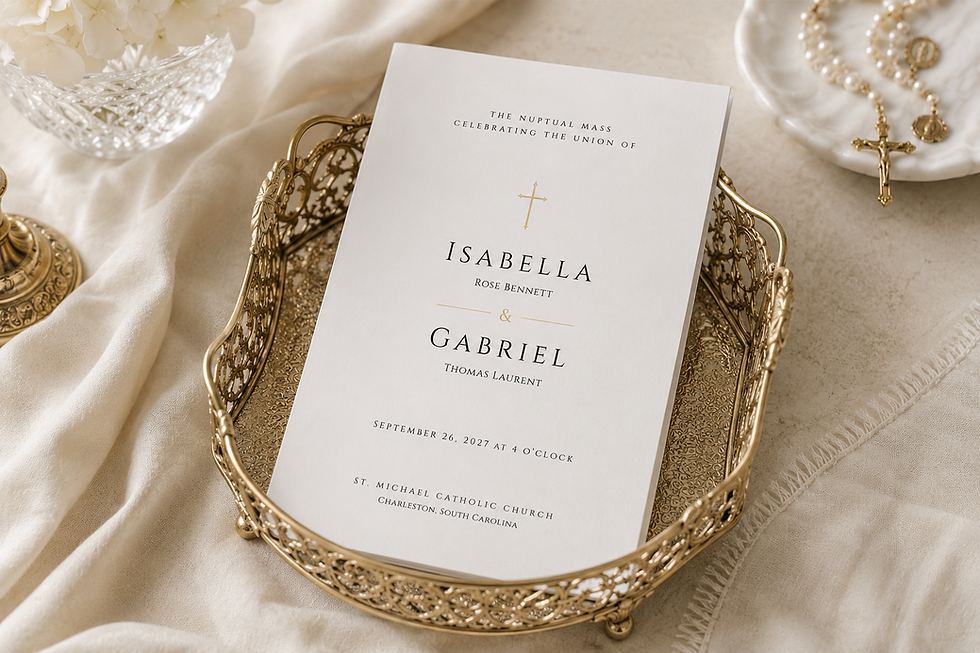
Once your readings are settled, a practical question follows: how much of this belongs in your wedding program? A well-made Nuptial Mass program can include the Scripture references, the names of your readers, the Responsorial Psalm and its response, the congregation's responses, gentle cues for when to sit, stand, or kneel, and a little guidance for guests who may be unfamiliar with the Mass — a real kindness when your celebration includes people of other traditions or none.
One caution worth flagging: reproducing the full text of Scripture in a program isn't as simple as copy-and-paste. There are permissions and copyright considerations around liturgical translations, and your parish will have guidance on what should and shouldn't appear. So before you finalize the layout, confirm exactly what's permitted for your program.
If you're building one, this is a place we can genuinely help. Catholic Vows Co. offers editable Catholic wedding Mass programs designed specifically around the flow of the liturgy — including options that help guests who may be unfamiliar with the Mass follow along more easily. It's the kind of detail that's much easier when the template already understands the shape of the celebration.
(You may also find these blog resources helpful as you plan: Catholic wedding ceremony vs. Nuptial Mass] and Catholic wedding timeline.)
A Final Thought: Choose Readings You Can Return To
The flowers, the invitations, the reception you've dreamed about — these are beautiful, and they're worth celebrating. But they belong, mostly, to a single day.
These words don't. Long after the day itself, the Scriptures you choose can stay with you. So choose ones you can come back to. Write them down somewhere you'll find them. Keep your wedding program. Mark the passages in a Bible with your names and the date. And on your anniversaries — or on the ordinary Tuesdays, or in the seasons when marriage is joyful, or hard, or simply quiet — return to them and read them again. They have a way of meaning more the longer you're married, not less.
Because the goal was never to assemble the most impressive combination of readings. It's something simpler and far more beautiful: to listen carefully to God's Word, and — with the guidance of the Church and your own parish — to choose the Scriptures that will walk beside you as you begin your life together.
That's a decision worth making slowly and intentionally.


Comments