Catholic Wedding Invitation Wording: What to Put on a Catholic Wedding Invitation

You already know the basics your invitation needs: your names, the date, the place. The part that stalls most Catholic couples comes right after that. Do you say "Nuptial Mass"? Is it appropriate to use "Sacrament of Holy Matrimony"? How do you word a church wedding so it still sounds like a wedding and not a parish bulletin? Does the wording change when your parents are hosting, or when one of you is not Catholic? And does the reception belong on the main invitation at all?
This article answers those questions with wording you can actually use. You will find complete, copyable examples for the most common Catholic wedding situations, along with a short explanation under each one so you know why it works and when to reach for it.
What Information Goes on a Catholic Wedding Invitation?
A Catholic wedding invitation carries the same core pieces as any formal invitation, arranged in a familiar order:
The names of the hosts, when someone is formally hosting (or bride and groom)
The bride's and groom's names
The request or invitation line ("request the honor of your presence," "together with their families," and so on)
The wording that identifies the Catholic celebration, whether that is a Nuptial Mass or a marriage celebrated outside Mass
The date
The time
The name of the church
The city and state
Reception information, either on the invitation ("reception to follow") or on a separate reception card
RSVP and other logistical details, usually on their own card
The guiding idea is simple. Your invitation does not have to sound archaic to be correct, but the wording should accurately reflect what is actually being celebrated. A Catholic wedding is a sacred act of worship, not only a social event, and the language can honor that without becoming stiff or confusing.
Should You Say "Nuptial Mass" on a Catholic Wedding Invitation?
This is the question that sends most couples searching, so here is the clear answer.
Whether you name the Nuptial Mass depends on whether your marriage is being celebrated within Mass. If you are exchanging vows during a full Mass that includes the Liturgy of the Eucharist, then you are being married at a Nuptial Mass, sometimes called a wedding Mass, and you may name it on your invitation. If your marriage is being celebrated outside of Mass, in a ceremony built around the Liturgy of the Word and the exchange of vows without the Eucharist, then it is not a Nuptial Mass and should not be called one.
When a Nuptial Mass is appropriate, wording like this works beautifully:
request the honor of your presence at the Nuptial Mass celebrating the marriage of
A slightly warmer version reads:
invite you to share in the joy of the Nuptial Mass uniting
Naming the Nuptial Mass is a lovely, accurate choice, and it signals to guests that the ceremony is a full Mass they are invited to take part in. However, it is not is a requirement. Many entirely correct Catholic invitations never name the liturgical form at all. They simply invite guests to the wedding, or to the celebration of the couple's marriage, and that is perfectly appropriate. So use "Nuptial Mass" because it is true and because you want to, not because you think every Catholic invitation must say it. It's simply a matter of preference!
Can You Say "Sacrament of Holy Matrimony"?
Yes, and when it fits, it is some of the most distinctly Catholic wording available to you. A line such as to celebrate the Sacrament of Holy Matrimony names marriage for what the Church understands it to be, and it reads with real dignity on a formal invitation.
One point of accuracy matters here. In Catholic teaching, marriage is a sacrament between two baptized persons. When both the bride and groom are baptized Christians, "Sacrament of Holy Matrimony" is precise and fitting. When one party is not baptized, the marriage can still be valid and holy, entered into with the Church's blessing, but it is not a sacrament in the strict theological sense. In that case, warm and Catholic wording like to celebrate their marriage in the sight of God or as they are joined in Holy Matrimony carries the same reverence without making a sacramental claim that does not apply.
You do not need to turn your invitation into a canon law seminar, and no guest expects you to. You only need the words on the card to be true. If you are unsure which situation is yours, your priest or parish marriage coordinator can confirm whether your celebration is sacramental and whether it includes Mass.
Catholic Wedding Invitation Wording Examples
This is the section to bookmark. Below are complete examples for different hosting arrangements and different tones. Use them as they are, or swap in your own names, church, and city. Under each one is a short note on why it works and who it suits.
Traditional Catholic Wedding Invitation — Parents Hosting
Mr. and Mrs. Thomas Whelan request the honor of your presence at the marriage of their daughter Catherine Rose to Michael James Donnelly
Saturday, the twelfth of June two thousand twenty-seven at two o'clock in the afternoon
Saint Joseph Catholic Church Fort Wayne, Indiana
Why it works: This is the classic form when the bride's parents are the hosts. "Request the honor of your presence" is the traditional phrasing for a ceremony in a house of worship, and naming the parents first reflects that they are issuing the invitation. If your wedding is within Mass, you can add a line after the church name, at a Nuptial Mass, or place Nuptial Mass beneath the time.
Catholic Wedding Invitation — Both Families Hosting
Together with their families
Catherine Rose Whelan and Michael James Donnelly
Request the honor of your presence as they are united in the Sacrament of Holy Matrimony
Saturday, the twelfth of June, two thousand twenty-seven at two o'clock in the afternoon
Saint Joseph Catholic Church Fort Wayne, Indiana
Why it works: "Together with their families" has quietly become the most useful modern option, and for good reason. It honors both sets of parents without the puzzle of fitting four names and two surnames onto one line, and it works gracefully whether the families are blended, whether parents have remarried, or whether contributions are shared. It reads as warm and current while staying entirely appropriate for church.
Catholic Wedding Invitation — Couple Hosting
With joyful and grateful hearts
Catherine Rose Whelan and Michael James Donnelly
Invite you to share in the celebration of their marriage
Saturday, the twelfth of June, two thousand twenty-seven at two o'clock in the afternoon Saint Joseph Catholic Church Fort Wayne, Indiana
Why it works: When you are hosting your own wedding, you lead with your own names. A single warm opening line sets the tone without tipping into sentimentality. If "joyful and grateful hearts" is more than you want, an elegant and straightforward alternative is simply Catherine Rose Whelan and Michael James Donnelly invite you to the celebration of their marriage. Both are correct. Choose the one that sounds like you reading it aloud.
Nuptial Mass Invitation Wording
When your ceremony is a full Mass, here is Nuptial Mass invitation wording in three registers.
Formal:
Mr. and Mrs. Thomas Whelan request the honor of your presence at the Nuptial Mass at which their daughter Catherine Rose will be united in marriage to Michael James Donnelly
Traditional:
Request the honor of your presence at the Nuptial Mass celebrating the marriage of Catherine Rose Whelan and Michael James Donnelly
Modern and elegant:
Catherine and Michael joyfully invite you to the Nuptial Mass celebrating their marriage
Why it works: Each version names the Mass so guests understand they are invited to a full liturgy, including Catholic friends and family who will want to receive the Eucharist. The only real rule here is the one from the earlier section: use this wording only if Mass is genuinely part of your celebration.
Catholic Wedding Ceremony Without Mass Invitation Wording
If your marriage is being celebrated outside of Mass, your invitation should reflect that. Do not write "Nuptial Mass," because there is no Mass. This is common and completely valid, and it is often the right liturgical form when one spouse is not Catholic. The ceremony still includes Scripture, the exchange of vows, and the Church's blessing.
Appropriate wording simply invites guests to the marriage itself:
request the honor of your presence at the celebration of their marriage
or
as they are united in Holy Matrimony
Why it works: These lines are reverent and accurate for a marriage celebrated without Mass. They carry clear Catholic weight without claiming a Mass that is not happening. If you want to understand exactly what this liturgy includes and how it differs from a wedding within Mass, see our full guide, Catholic Wedding Ceremony Vs. Nuptial Mass Explained.
Catholic Wedding Invitation When One Spouse Is Not Catholic
When one of you is not Catholic, your invitation does not need to announce anyone's religion. The exact form of your ceremony, whether it is within Mass or outside Mass, depends on your particular circumstances and on what you and your priest or parish have arranged. The invitation's job is only to invite people to the wedding you are actually having.

Together with their families
Catherine Rose Whelan and Michael James Donnelly
Request the honor of your presence at the celebration of their marriage
Saturday, the twelfth of June, two thousand twenty-seven at two o'clock in the afternoon
Saint Joseph Catholic Church Fort Wayne, Indiana
Why it works: The wording is explicitly Christian in setting and tone, held in a Catholic church and inviting guests to a marriage, without labeling either spouse or overstating the liturgical form. It is gracious to a mixed gathering of guests and accurate to a wide range of arrangements. If your celebration is within Mass, add at a Nuptial Mass; if it is not, the wording above is ready as written.
Very Formal Catholic Wedding Invitation Wording
Mr. and Mrs. Thomas Edward Whelan request the honor of your presence at the Nuptial Mass uniting their daughter
Catherine Rose and Mr. Michael James Donnelly
On Saturday, the twelfth of June two thousand twenty-seven
At half past two o'clock in the afternoon
The Cathedral of the Immaculate Conception
Fort Wayne, Indiana
Black tie
Why it works: Full names including middle names, a spelled-out date and time, courtesy titles, and a cathedral setting all signal a formal celebration. This register suits a traditional church wedding followed by a black-tie reception, and it pairs naturally with a more elevated invitation design.
Simple Modern Catholic Wedding Invitation Wording
Catherine and Michael are getting married
Saturday, June 12, 2027 · 2:00 in the afternoon
Saint Joseph Catholic Church · Fort Wayne, Indiana
Celebration to follow
Why it works: For couples who do not want formal parent-host language or spelled-out dates, this clean contemporary style stays warm and legible. Notice that it still identifies a Catholic church by its proper name, so even a minimalist invitation makes clear what kind of wedding this is. Simple is not the same as vague.
"Request the Honor of Your Presence" vs. "Request the Pleasure of Your Company"
This is a genuine etiquette distinction, but it is worth understanding clearly first. By tradition, request the honor of your presence is used when the ceremony takes place in a house of worship, and request the pleasure of your company is used for a celebration at a secular venue, such as the reception. That is why many wedding suites use the first phrase on the ceremony invitation and the second on the reception card.
Here is the part that matters for your peace of mind: this is an invitation-etiquette tradition, not a Catholic liturgical requirement. The Church does not mandate either phrase. No priest will object, and your marriage is in no way affected by which one you choose. Use "honor of your presence" because it is the customary and fitting phrase for a church wedding, and feel free to set the tradition aside if your invitation's voice calls for something else. (The older British spelling "honour" is equally correct; pick one spelling and use it consistently throughout your suite.)
How Should You List the Catholic Church?
List the church by its full, official name, then the city and state:
Saint Joseph Catholic Church
Fort Wayne, Indiana
A few practical notes. Match the parish's official name exactly, since many parishes have a specific dedication ("Saint Joseph," "Most Precious Blood," "Saint Therese, Little Flower") that guests and search maps will recognize. The street address usually does not need to crowd the formal invitation. If your guests can find the location on your wedding website or a details card, the church name and city are enough. Include the street address only when there is a practical reason, such as a church that is easy to confuse with another parish of the same name nearby.
Do You Put the Reception on the Catholic Wedding Invitation?
You have two clean options, and both are correct.
If the reception is at the same location or follows immediately, you can add a short line at the bottom of the invitation:
Reception immediately following The Gardens at Heritage Hall
If the reception is elsewhere, needs its own details, or you simply want the main invitation to stay focused on the ceremony, put the reception on a separate reception card within the suite, or on your wedding website. A separate card is the more formal choice and keeps the invitation itself uncluttered. This is also where a coordinated invitation suite earns its keep: a matching reception card, details card, and RSVP card let each piece do one job well, so the invitation can stay devoted to the sacred part of the day.
What About Dress Code, Wedding Website and RSVP Information?

Keep the main invitation for the essentials. Dress code, wedding website, hotel blocks, parking notes, and RSVP instructions all tend to make an invitation feel crowded, and they have better homes:
A details card for dress code, the wedding website address, directions, and accommodations
An RSVP card, if you are using one, for the reply itself and any meal choices
Your wedding website for everything that would otherwise require a small paragraph
A well-designed invitation suite is built exactly for this division of labor, so each card stays elegant and easy to read. Catholic Vows invitation suites include coordinated details and RSVP cards for this reason, letting your invitation stay focused while the practical information still reaches your guests.
Catholic Wedding Invitation Wording Mistakes to Avoid
A handful of missteps come up again and again. Each is easy to avoid once you know to look for it.
Calling the ceremony a Nuptial Mass when there is no Mass. If your marriage is being celebrated outside Mass, do not use "Nuptial Mass." Invite guests to the celebration of your marriage instead.
Packing too much onto the invitation. Dress code, directions, registry hints, and hotel blocks belong on a details card or your website, not the invitation.
Using religious language just because it "sounds Catholic." Do not reach for "Sacrament of Holy Matrimony" or other phrases without knowing whether they accurately apply to your celebration. Correct wording beats impressive-sounding wording every time.
Leaving off the official church name, or getting it wrong. Use the parish's full, proper name so guests and maps find the right place.
Making the invitation so formal that no one can tell what is happening. If a guest cannot work out the date, the place, or the fact that this is a wedding, the wording has failed, however elegant it looks.
Treating etiquette customs as though they were Church requirements. "Honor of your presence," spelled-out dates, and courtesy titles are etiquette traditions you are free to follow or adjust. They are not rules the Church imposes, and no one should feel anxious about them.
Catholic Wedding Invitation Wording FAQ
What should a Catholic wedding invitation say?
It should name the hosts (if any), the bride and groom, an invitation line, the Catholic celebration (a Nuptial Mass or a marriage celebrated outside Mass), the date, time, church name, and city and state. Reception and RSVP details can go on separate cards.
Do Catholic wedding invitations say Nuptial Mass?
They can, when the marriage is celebrated within a full Mass. It is an accurate and beautiful choice, but it is not required. Many correct Catholic invitations simply invite guests to the wedding or the celebration of marriage without naming the liturgical form.
Is "Holy Matrimony" appropriate for a Catholic wedding invitation?
Yes. "Holy Matrimony" is fitting and distinctly Catholic. Use "Sacrament of Holy Matrimony" when both spouses are baptized Christians, since that is when marriage is a sacrament in the strict sense. When one spouse is not baptized, phrasing like "united in Holy Matrimony" or "celebrate their marriage" is the more precise choice.
How do you word a Catholic wedding invitation when the couple is hosting?
Lead with your own names and a brief invitation line, for example, Catherine Rose Whelan and Michael James Donnelly invite you to share in the celebration of their marriage, followed by the date, time, and church.
Do you put the priest's name on a Catholic wedding invitation?
Generally, no. The priest's name is not part of standard invitation wording. It is more commonly included in the Mass program or order of worship than on the invitation itself.
Should the Catholic church address be on the invitation?
Usually the church name with the city and state is enough, especially when the address is on your details card or wedding website. Include the street address only when there is a practical reason, such as distinguishing between two parishes of the same name.
Do Catholic wedding invitations need religious wording?
No. An invitation can be simple and still accurately identify the event. Naming the Catholic church and inviting guests to the couple's marriage is enough; additional religious language is a meaningful option, not a requirement.
Choosing Wording That Fits the Wedding You Are Planning

The best Catholic wedding invitation wording is beautiful, clear, and accurate to the celebration you are actually having. If it is a Nuptial Mass, say so with joy. If it is a marriage outside Mass, invite your guests to exactly that. Name your church correctly, keep the card itself uncluttered, and let the words be true.
Once you have settled on your wording, the next step is finding an invitation worthy of the church wedding you are planning. Shop Catholic Wedding Invitations to see suites designed for couples who want their stationery to feel as sacred as the day. Our collections each pair beautifully with the wording above and can be adjusted to suit any wording based on your situation and preferences- from the very formal cathedral invitation to the simple modern card.
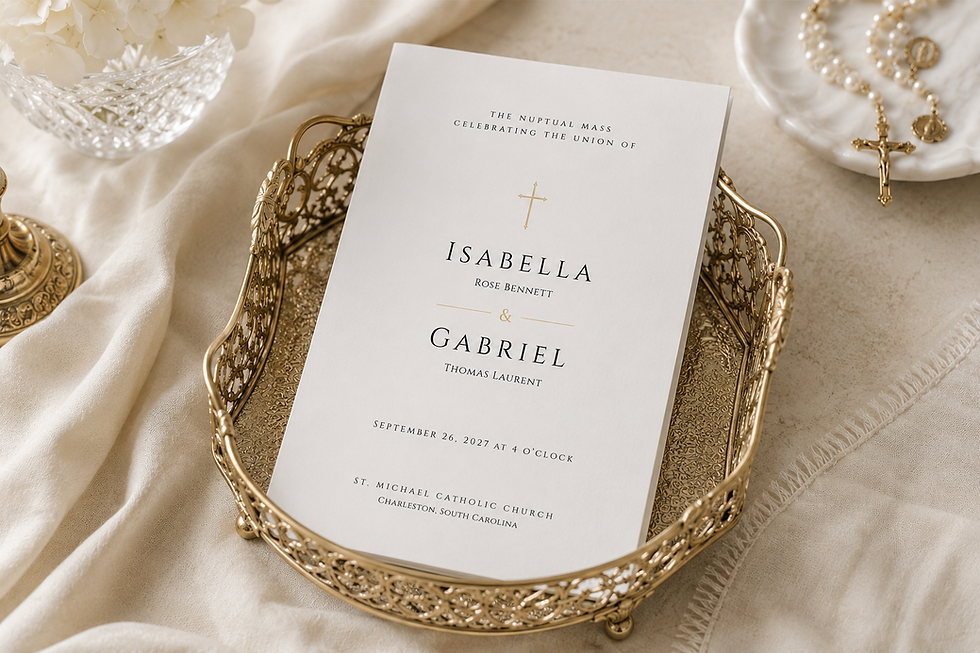
And when the invitation is chosen, you can carry that same care into the ceremony itself with a coordinated Catholic wedding Mass program that guides your guests through the liturgy.
Comments