Catholic Wedding Communion Etiquette: What Should Non-Catholic Guests Do?

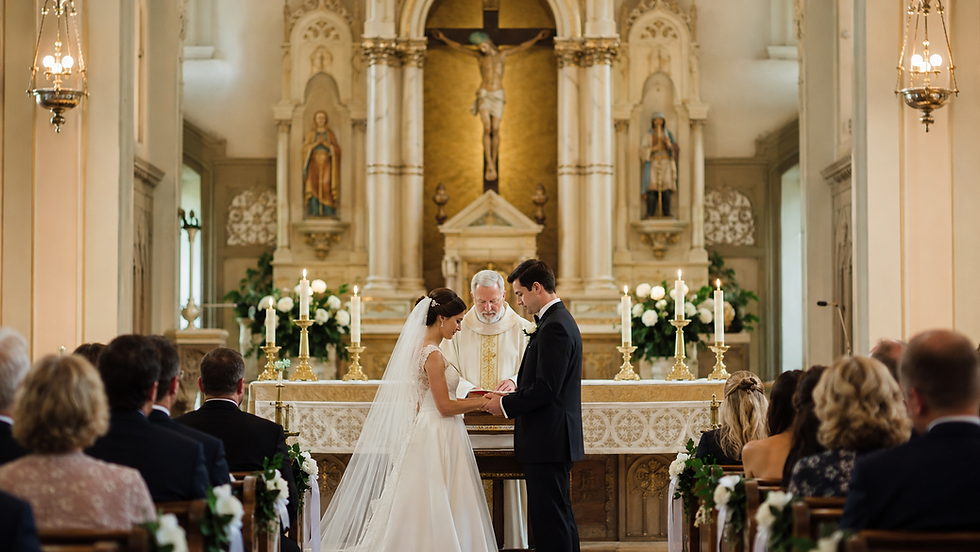
You've invited your Protestant grandmother, your Baptist college roommate, your husband's Methodist relatives, and a handful of friends who have never set foot in a Catholic church. The planning is going beautifully—and then you reach the Communion portion of your wedding Mass and it hits you: What are all these people actually supposed to do when everyone starts getting up?
Here's the short, reassuring answer:
Non-Catholic guests are absolutely welcome at a Catholic wedding Mass, but non-Catholic Christians do not receive Holy Communion. They can simply remain in their pew and pray during Communion.
That doesn't mean they're unwelcome at your wedding or excluded from the celebration. Not even close. Their presence is a gift, and the Church genuinely wants them there. Sitting quietly during Communion is a normal, gracious, completely appropriate thing to do—and it's what a great many wedding guests do every single weekend.
And you don't need to awkwardly pull 75 people aside and explain the situation one by one. A short, thoughtfully worded note in your wedding program can quietly take care of most of the confusion before it ever starts.
Let's walk through all of it together, so you understand not just what to do, but why—and so you can handle the whole thing with warmth and confidence.
Can Non-Catholics Receive Communion at a Catholic Wedding?
Usually, no.
Most baptized Christians who are not in full communion with the Catholic Church ordinarily do not receive Holy Communion at a Catholic Mass. That's the practical answer that covers the overwhelming majority of your guests.
It's worth being precise, though, because the internet often isn't. There are limited provisions in canon law for exceptional circumstances, and there are particular considerations involving members of some Eastern Churches, including Orthodox Christians. So the blanket statement "only Roman Catholics may ever receive Communion" isn't quite accurate.
What that means for you as a bride is refreshingly simple: a wedding blog—and a wedding couple—should never try to determine whether an individual guest qualifies for an exception. If a specific person believes an unusual situation applies to them, the right move is for that person to speak directly with the priest. That's it. You are not the gatekeeper of the Communion line, and you don't have to be.
The USCCB's own guidance says as much: non-Catholic Christians are ordinarily not admitted to Communion, while acknowledging that limited canonical exceptions exist and that there are particular provisions concerning members of certain Eastern Churches.
Why Doesn't the Catholic Church Practice Open Communion?
This is the heart of it, so let's keep it simple and beautiful.
Catholics believe the Eucharist is truly the Body and Blood of Jesus Christ. Not a symbol of him. Not a reminder of him. Him.
That belief changes what receiving Communion means. It isn't simply:
participating in the wedding
showing support for the couple
demonstrating that you're a Christian
joining in because everyone else is
Holy Communion also expresses communion—a real, existing unity with the Catholic Church's faith and sacramental life. Receiving says, in effect, "I share this faith and this life." That's why the Church warmly welcomes everyone to be present at Mass, while reserving the reception of the Eucharist according to Catholic sacramental discipline.
One thing to hold onto: the distinction isn't about deciding which guests are worthy or which guests are welcome. A devout Protestant grandmother may have a richer prayer life than half the Catholics in the room. This isn't a ranking of holiness or a measure of how much God loves anyone. It's about what the act of receiving Communion actually expresses.
So What Should Non-Catholic Guests Do During Communion?

They may simply remain in their pew, and be invited to reflect and pray.
While others go forward, a non-Catholic guest can:
sit or kneel, whatever feels comfortable and appropriate
pray quietly
listen to the Communion hymn
offer a prayer for the newly married couple
pray for Christian unity
And they do not need to:
explain themselves to anyone
pretend to be Catholic
receive Communion just because everyone around them is moving
feel one ounce of embarrassment about staying behind
The USCCB even encourages those who aren't receiving to prayerfully express a desire for unity with Christ and with one another—which is a beautiful thing to be doing while a couple begins their marriage.
So if you take away one line to pass along to a nervous relative, let it be this: remaining in the pew during Communion is completely okay. For a lot of your guests, that single sentence dissolves nearly all the anxiety.
Should Non-Catholic Guests Go Forward for a Blessing?
This one deserves extra care, because a lot of wedding websites get it wrong.
You've probably seen the advice: tell your non-Catholic guests to join the Communion line, cross their arms over their chest, and receive a blessing from the priest. It sounds tidy and welcoming.
Practices genuinely differ from parish to parish and diocese to diocese.
Some parishes warmly invite people who aren't receiving Communion to come forward for a blessing.
Others prefer that those who aren't receiving simply stay in their pews—partly because the entire congregation receives a blessing together near the end of Mass anyway.
So here's the most useful practical takeaway in this whole article: ask your priest or parish wedding coordinator what your parish would like guests who aren't receiving to do—before you print any instructions in your program. A one-minute conversation saves you from confidently telling 40 people to do something your celebrant doesn't actually want them doing.
What If My Fiancé Isn't Catholic?
If you're marrying someone who isn't Catholic, take a breath—this is well-worn, well-loved territory, and the Church has thought carefully about it.
If you're Catholic and your fiancé is a baptized Christian from another tradition, the wedding is generally celebrated outside of Mass. The USCCB's marriage guidance notes that the Rite of Marriage outside Mass is normally used when a Catholic marries a baptized person from another Christian community.
Part of the pastoral wisdom behind that is exactly the situation you might be worried about: it spares the couple the moment where one newly married spouse receives the Eucharist at the altar while the other cannot ordinarily do so. Celebrating the marriage outside Mass lets the two of you stand together, fully, in the moment you become husband and wife.
If you're Catholic and your fiancé is not baptized, the appropriate marriage rite is likewise celebrated without Mass.
You don't need to wade through canon-law vocabulary to plan your wedding well. The single most important thing to know is this: the priest preparing you for marriage will determine the appropriate form together with you.
What If We're Both Catholic but Lots of Our Guests Aren't?
That is completely, wonderfully normal.
Having Protestant, Orthodox, Jewish, Muslim, atheist, agnostic, fallen-away, or never-been-to-Mass guests in your pews does not mean you should shrink or apologize for the Catholic character of your wedding. Your wedding gets to be fully Catholic.
The goal isn't to minimize what's happening—it's to help people understand what's happening. When guests know what to expect, they relax, and they can actually enter into the joy of the day.
A few practical ways to do that:
include a concise Communion explanation in your program
add sit/stand/kneel cues if that fits your parish
name the major parts of the Mass so people can follow along
briefly explain any unfamiliar Catholic traditions
make sure your ushers know that not everyone will get in the Communion line
ask whether your priest will make a short announcement, as many do
Hold onto this, because it's the theme of the whole day: hospitality and clarity can absolutely coexist with fidelity to the Eucharist. You don't have to choose.
What About Catholics Who Aren't Receiving Communion?

Here's a nuance that keeps your wedding from turning into an accidental "Catholics up front, everyone else stays seated" moment—because reality is more layered than that.
Being Catholic doesn't automatically mean a person should receive Communion at every single Mass. Catholics are called to receive when they are properly disposed to receive Holy Communion, according to the Church's sacramental discipline. Sometimes a faithful Catholic simply isn't, on a given day, and quietly stays in the pew.
There's no need to get into the weeds of exactly why. The point for your wedding is gentle and freeing: a Catholic guest who isn't receiving can also just remain prayerfully in the pew, right alongside your non-Catholic guests. So if your Protestant roommate looks around and notices she's not the only one seated, that's not an accident—it's normal.
What Should Non-Christian Guests Do?
Every bit as welcome.
Your Jewish aunt, your college friend who's an atheist, your fiancé's Muslim coworker—they are all welcome to:
attend the wedding
be respectfully present
sit and stand as they're comfortable
listen
pray according to their own conscience
remain in their pew during Communion
The USCCB's guidance explicitly welcomes those who don't share Christian faith to the Eucharistic celebration, while explaining simply that they don't receive Holy Communion. That's not a "no trespassing" sign—it's an open door with one honest note attached. Your guests are being invited in, not kept out.
Do Non-Catholic Guests Have to Kneel?
Someone unfamiliar with Mass will usually just follow the people around them, and that's perfectly fine.A guest who doesn't feel comfortable kneeling can generally remain seated, respectfully, rather than performing a gesture that doesn't mean anything to them.
Postures can vary somewhat from place to place, so this is one more small reason that a little sit/stand/kneel guidance in your program is such a kindness—it lets guests follow along without feeling like they're guessing.
Should We Explain Communion Before the Wedding?
Yes—but it doesn't require an awkward family announcement at the rehearsal dinner.
You've got several graceful options, and you can mix and match:
Wedding program. Probably the cleanest, calmest option. It's already in everyone's hands, and it does the explaining for you. If you need help forming one, we've already done the work for you, all you have to do is edit! Browse our Catholic Mass Programs here.
The priest's announcement. Many priests offer a brief word about who receives Communion right before that part of Mass. Ask yours if he typically does.
Wedding website. A short "What to Expect at Our Catholic Wedding" page can quietly answer questions ahead of time for the curious.
Private conversations. Worth it in one specific case: when a close relative may be expecting to receive and you can foresee genuine hurt or confusion. A warm heads-up beforehand is far kinder than a surprise in the moment.
What Should We Put in Our Catholic Wedding Program About Communion?
This is where a well-made program earns its keep. Good Communion wording does three things at once:
Welcomes the guest warmly.
Explains the Church's practice without sounding apologetic or stiff.
Tells people what they can do instead of receiving.
Here are three sample options you can adapt. A quick but important note first: these are starting points written in plain, friendly language—not official Church texts. Please have your priest or parish review your final wording before it goes to print, and don't tell guests to come forward with crossed arms unless your parish specifically directs that practice.
Option 1 — Warm and concise
We're so glad you're here to celebrate with us. During our wedding Mass, Catholics who are properly disposed will receive Holy Communion. If you are not receiving, you are warmly invited to remain in your pew and pray with us—for our marriage, and for the unity of all Christians. Your presence means the world to us.
Option 2 — A little more traditional
In the Catholic Church, the reception of Holy Communion expresses a shared unity of faith and life. For this reason, Holy Communion is ordinarily received by Catholics who are properly disposed. All of our guests are cherished members of this celebration; those who are not receiving are invited to remain in prayer during this time. We are deeply grateful for your presence with us today.
Option 3 — Especially helpful for many non-Catholic guests (plain English)
A quick note about Communion: in the Catholic Church, receiving Communion is a sign of full unity with the Church's faith, so it's ordinarily received by Catholics. If that's not you, please don't feel out of place—simply stay in your seat and, if you'd like, say a prayer for us. Lots of our favorite people will be doing exactly that. Thank you for being here.
Pick whichever voice sounds most like you two, adjust it freely, and let your parish give it a final look.
How to Make Non-Catholic Guests Feel Welcome at a Catholic Wedding Mass

Guests almost always feel more at ease—not less—when someone simply tells them what's going on. Confusion is what makes people uncomfortable, not reverence.
So set them up to succeed:
provide a clear, easy-to-follow program
identify the readings and hymns
briefly explain any unfamiliar traditions
include posture cues when appropriate
offer a simple, warm Communion explanation
ask your priest whether he'll give any instructions
let guests know they're welcome to remain seated when they aren't participating
take care not to make non-Catholic family members feel singled out
And the thought at the center of all of it:
Your guests don't need to know how to "perform" being Catholic in order to be welcomed at your Catholic wedding. They just need to be told they're wanted—and shown how to follow along.
A Note for Brides Worried About Offending Someone
Maybe your worry has a specific face:
"My mother-in-law is Protestant."
"My sister left the Church."
"My best friend is a devout Christian who receives Communion at her own church every Sunday."
"My fiancé's family believes everyone should be able to receive."
This can feel deeply personal, because Communion carries different meanings and practices across Christian traditions. Someone who receives every week at her own church may feel a pang at not receiving at yours—and that's understandable.
Here's the good news: you do not have to turn your wedding into a theological debate. You don't have to win an argument or defend the Church over the appetizers. You can simply say, with love:
"We're following the Catholic Church's practice for Communion at our wedding Mass, and we're so grateful you're here to celebrate with us."
That's a complete answer. It's honest, it's warm, and it doesn't put anyone on trial. And if one particular situation feels genuinely complicated, you don't have to untangle it yourself—bring it to the priest. That's exactly what he's there for.
Catholic Wedding Communion Checklist
Bookmark this one:
☐ Confirm whether your wedding will be celebrated within Mass
☐ Ask your priest what non-communicating guests should do
☐ Ask whether your parish invites people forward for a blessing or prefers they remain seated
☐ Decide whether to include Communion guidance in your program
☐ Have the parish review your wording
☐ Include sit/stand/kneel guidance if appropriate
☐ Make sure your ushers know some guests will remain in their pews
☐ Discuss any unusual situation involving the bride or groom directly with the priest
☐ Finalize your program before printing
Your Wedding Program Can Do More Than List the Ceremony
For a Catholic wedding with many non-Catholic guests, your program can be so much more than a list of names and songs. It can quietly answer the questions guests may otherwise be afraid to ask—when to sit or stand, what part of the liturgy is happening, what Communion means, and exactly what to do if they aren't receiving. It does the gentle explaining, so you don't have to.
That's the thinking behind Catholic Vows wedding Mass programs. Selected designs are built to include:
guest guidance
sit/stand/kneel cues
the complete Mass structure
wedding-party information
memorial sections
customizable details
If you'd like your program to carry some of this weight for you, explore Catholic Wedding Mass Programs →

Frequently Asked Questions
Can non-Catholics take Communion at a Catholic wedding? Ordinarily, no—most non-Catholic Christians do not receive Holy Communion at a Catholic Mass. Limited canonical exceptions and particular provisions for members of certain Eastern Churches do exist, but a couple shouldn't try to sort those out themselves; any unusual situation should go to the priest.
What should a non-Catholic do during Communion? Remain prayerfully in the pew. Sit or kneel comfortably, listen to the hymn, and if you'd like, pray for the couple or for Christian unity.
Can a Protestant receive Communion at a Catholic wedding? Ordinarily no—even if that person receives Communion in their own Christian community—because in the Catholic Church, receiving Communion expresses full unity with the Church's faith and sacramental life.
Can non-Catholics go up for a blessing? It depends on the parish. Some invite it; others prefer guests remain seated. Ask your priest before printing that instruction in your program.
Should non-Catholic guests sit or kneel during Communion? Either is fine. Guests should be respectful, but no one needs to perform a posture that's unfamiliar—remaining seated quietly is perfectly appropriate.
Can my non-Catholic fiancé receive Communion at our wedding? As a general rule, no—and this is exactly the kind of question to bring to the priest preparing you for marriage rather than settle from an article. He'll walk you through the right form for your wedding.
Can Catholics stay seated during Communion? Yes. No Catholic is required to receive Communion at every Mass; a Catholic receives when properly disposed to do so.
Will it be awkward if half our wedding guests don't receive Communion? No. This is genuinely common, especially at weddings and funerals attended by people from many backgrounds. A little preparation makes it feel completely natural.
Should we put Communion instructions in our wedding program? For a wedding with many guests unfamiliar with the Catholic Mass, yes—it's one of the kindest and most useful things you can do.
Bringing It All Together
Having non-Catholic guests at your wedding Mass does not have to create an uncomfortable Communion moment. A little preparation makes an enormous difference.
You really can do both: you can welcome your guests generously and let the Eucharist remain exactly what Catholics believe it to be—the Body and Blood of Christ, and the sign of the Church's sacramental communion. Those two things were never in competition.
So ask your parish about its Communion procedures, include a simple explanation for your guests, and then let everyone do the thing they actually came to do: celebrate the beginning of your marriage.
Planning the details of your liturgy? You might also like What to Include in a Catholic Wedding Mass Program. Still deciding on the shape of your ceremony? See Catholic Wedding Ceremony vs. Nuptial Mass: What's the Difference?


Comments